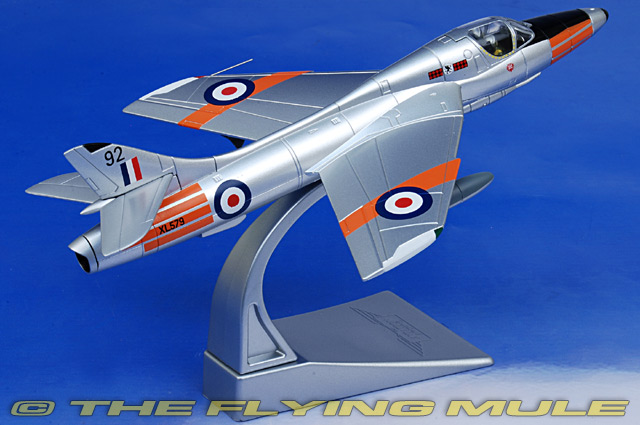
Corgi Aviation Archive Collector Series AA32712
Hawker Hunter T.Mk 7 Diecast Model
RAF No.229 OCU, XL579, RAF Chivenor, England, Early 1960s | Limited Edition
1800
Pieces Worldwide |
|
| 1:72 Scale | | Length | | Width |
|---|
| Hawker Hunter T.Mk 7 | | 7.75" | | 5.75" |
The RAF ordered 55 Hunter Trainer Mark 7 (T.7) aircraft, with the first flying on 11th October 1957, and the first deliveries following shortly after. Only 45 of the 55 ordered were delivered to the RAF, with the other ten diverted to the Royal Navy FAA. The RAF also received six additional T.7s as conversions from ex-RAF F.4s. No.234 Sqn, RAF had flown Spitfires in the Battle of Britain and went on to fly Vampires, Sabres and Hunters until it was disbanded on 15th July 1957. The Squadron number was then allocated to one of the squadrons of No.229 OCU on 22nd October 1958, operating Hunter F.6 and FGA.9 aircraft to give Hunter pilots their operational training. The Unit was also allocated a few two-seat Hunter T.7s including XL579. On 2nd September 1974, No.229 OCU was re-designated as the Tactical Weapons Unit (TWU) and No.234 (Reserve) Sqn remained one of its components.
Designed to exceed the performance of the straight-wing carrier-based Hawker Sea Hawk, the Hawker Hunter first flew on July 21, 1951. Early versions of this swept-wing aircraft suffered from a host of problems such as a short range (Maximum flight endurance was only about one hour) and an unreliable engine, but a series of refinements resulted in an aircraft that went on to become history's longest-serving British jet fighter, with almost 50 years on the front lines. The Hunter's high power-to-weight ratio and improvements in armament and fuel capacity made it an appealing export, and during its service history it was operated by 19 different nations. © Copyright 2003-2026 The Flying Mule, Inc.
Corgi's 1:72 scale Hunter series spans the long history of this aircraft, from its use during the cold war to its role in military aerobatics. The model is heavy, constructed with only the smallest amount of plastic. The canopy is removable, revealing an intricately detailed pilot figure. Large port collector blisters are easily seen below the cockpit, with four cannon ports located forward. The ventral mounted speed brake is easy to configure in either deployed or closed configurations. Keyed landing gear provides an uncomplicated configuration for ground display. F9 and late F6 variants feature housing over the tailpipe for the braking parachute.
© Copyright 2003-2016 The Flying Mule, Inc.
The Corgi "Aviation Archive" range presents highly-detailed, ready-made diecast models of military and civilian aircraft. The vast Aviation Archive range has become the standard by which all other diecast airplane ranges are judged. Each Corgi model is based on a specific aircraft from an important historical or modern era of flight, and has been authentically detailed from original documents and archival library material. Famous airplanes and aviators from both military and commercial airline aviation are all honored.
Corgi "Aviation Archive" diecast airplanes feature:
- Diecast metal construction with some plastic components.
- Realistic panel lines, antennas, access panels and surface details.
- Pad printed markings and placards that won't fade or peel like decals.
- Interchangeable extended/retracted landing gear with rotating wheels.
- Poseable presention stand to display the aircraft "in flight".
- Many limited editions with numbered certificate of authenticity.
- Detailed, hand-painted pilot and crew member figures.
- Authentic detachable ordnance loads complete with placards.
- Selected interchangeable features such as speed-brakes, opened canopies and access panels.
- Selected moving parts such as gun turrets, control surfaces and swing-wings.
© Copyright 2003-2026 The Flying Mule, Inc.