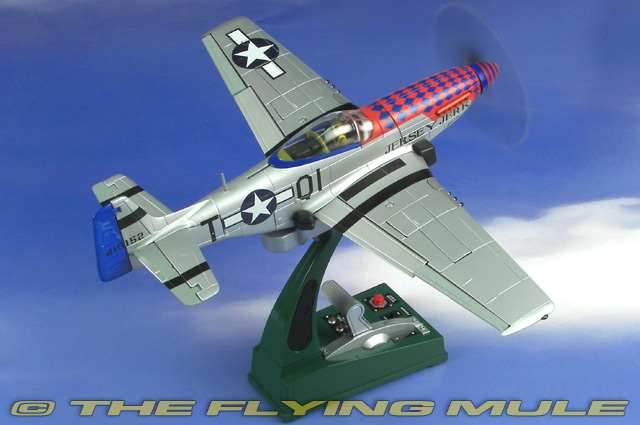
Corgi Aviation Archive Collector Series AA34406
North American P-51D Mustang Diecast Model
USAAF 356th FG, 361st FS, #44-15152 Jersey Jerk, Don Strait, RAF Martlesham Heath, England, 1945, Electronic Edition | Limited Edition
1610
Pieces Worldwide |
|
| 1:32 Scale | | Length | | Width |
|---|
| North American P-51D Mustang | | 12" | | 14" |
Squadron colors were not adopted by the 356th FG until December 1944, when colored rudders (yellow for the 359th FS, red for the 360th FS and blue for the 361st) were introduced, followed by colored spinners from February 1945. Not equipped with P-51s until November 1944, the same day that Don Strait assumed command of the 361st FS, the 356th FG was the 'hard luck' group of the Eighth, with a higher loss-to-kill ratio than any other fighter unit, claiming 201 aerial and 75.5 ground victories for the loss of 122 aircraft. Strait's 13.5 victories with the 361st FS, 356th Fighter Group, made him the top ace of this group, achieving all but three of his kills in Mustangs, largely in the final months of the war. He led the squadron again on November 26, 1944, when it flew an escort mission over the heavily defended Ruhr. After linking up with the B-17s just east of Holland, the pilots were advised of 40 bandits approaching from the south. As Strait's sixteen Mustangs arrived in the Osnabruck area, they spotted the 40 Bf 109s at 25,000 feet. They dropped tanks and attacked. Then Strait spotted about another 150 German fighters at various altitudes, preparing to attack the bombers. After two more victories on December 5, Strait found more air combat on Christmas Day. In action again against Bf 109s, he had a nasty moment when his first victim left oil and engine coolant all over his windscreen. Skidding away, Strait almost rammed his foe. He continued shooting down German planes in 1945 : an Fw-190 on Jan. 14, another Fw-190 on Feb. 14, and three Fiesler Storch light observation planes on Feb. 20. His 13.5 aerial victories led the 356th Fighter Group. After the war he rejoined the NJ Air National Guard, and served on active duty during the Korean War, the Fighter Group. After the war he rejoined the NJ Air National Guard, and served on active duty during the Korean War, the Cuban Missile Crisis, and Vietnam.
Celebrating an era of iconic aircraft in all their glorious detail, this is the world's first range of working diecast model aircraft. With working propellers, undercarriage and navigation lights all operated from a specially designed stand and accompanied by realistic engine sounds, this is as close to the real thing as you can get!
Designed to meet an RAF requirement for fighter-bomber and reconnaissance aircraft, the P-51 Mustang was first flown on October 26th, 1940. This versatile aircraft was capable of escorting bombers on long-range missions, engaging in dogfights, and dropping down to destroy German targets on the ground. At least eight versions of the P-51 were produced, but it was the definitive P-51D that gave the Mustang its classic warbird appearance. Britain and the US both tested the airframe with the Rolls-Royce Merlin engine, which gave the aircraft tremendous performance gains. The Truman Senate War Investigating Committee called the Mustang "the most aerodynamically perfect pursuit plane in existence." © Copyright 2003-2026 The Flying Mule, Inc.
Corgi's 1:32 scale P-51 Mustang is a large scale model loaded with features. All of the control surfaces, the landing gear and gear doors are moveable with metal hinges. The upper portion of the engine cowling is removable, revealing a masterfully rendered V-12 Merlin engine. Beneath the removable covers on each wing are detailed machine guns and ammo belts. The cockpit interior and detailed pilot figure are easily viewed with the canopy open or closed.
© Copyright 2003-2026 The Flying Mule, Inc.
The Corgi "Aviation Archive" range presents highly-detailed, ready-made diecast models of military and civilian aircraft. The vast Aviation Archive range has become the standard by which all other diecast airplane ranges are judged. Each Corgi model is based on a specific aircraft from an important historical or modern era of flight, and has been authentically detailed from original documents and archival library material. Famous airplanes and aviators from both military and commercial airline aviation are all honored.
Corgi "Aviation Archive" diecast airplanes feature:
- Diecast metal construction with some plastic components.
- Realistic panel lines, antennas, access panels and surface details.
- Pad printed markings and placards that won't fade or peel like decals.
- Interchangeable extended/retracted landing gear with rotating wheels.
- Poseable presention stand to display the aircraft "in flight".
- Many limited editions with numbered certificate of authenticity.
- Detailed, hand-painted pilot and crew member figures.
- Authentic detachable ordnance loads complete with placards.
- Selected interchangeable features such as speed-brakes, opened canopies and access panels.
- Selected moving parts such as gun turrets, control surfaces and swing-wings.
© Copyright 2003-2026 The Flying Mule, Inc.