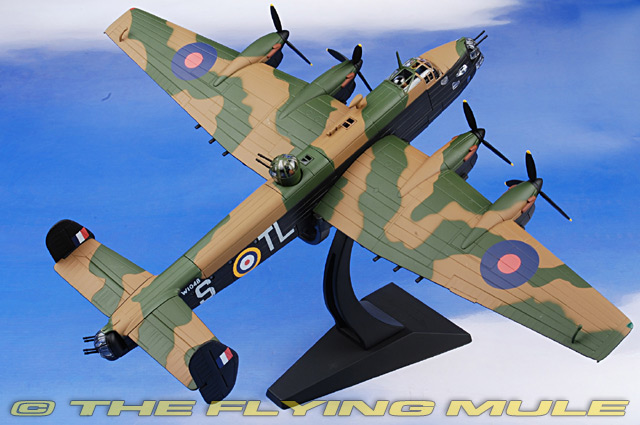
Corgi Aviation Archive Collector Series AA37201
Handley Page Halifax B.MK II Diecast Model
RAF No.35 Sqn, April 1942 | Limited Edition
2310
Pieces Worldwide |
|
| 1:72 Scale | | Length | | Width |
|---|
| Handley Page Halifax B.MK II | | 12" | | 17.25" |
On April 27, 1942, Halifax Mk.II Srs.1, W1048 flew up from the Scottish airfield Kinloss to its first and last operational light. Together with some other Halifaxes of the 35th Squadron and with airplanes of two further squadrons, it went to attack German battleship Tirpitz, which was anchored in Foettenfjord near Trondheim in Norway. Upon arrival, the crew threw down the load of four special spherical deep charges having a weight of 425 kgs each, then the aircraft was hit in the right utter engine, and landed forcibly on the icebound surface of Lake Hoklingen. five crew members escaped through Sweden; one of them as taken captive. Their plane sank to a depth of 27 meters until discovery in 1973, when he wreck was hoisted out and became a part of RAF Museum exposition at Hendon airfield.
Designed to meet an Air Ministry specification for a twin-engined "world-wide use" medium bomber, the Handley Page Halifax first flew on September 24, 1939. This aircraft was one of the first British bomber designs to use four engines. During WWII, it flew 82,773 operations for the RAF Bomber Command, dropping 224,207 tons of bombs. It also served as a glider tug and in special operations missions such as parachute drops of arms and agents over occupied Europe. Under the RAF Coastal Command, the aircraft served in reconnaissance and meteorological roles, and in anti-submarine warfare. After the war, Halifaxes went on to serve as freighters for British airlines. © Copyright 2003-2026 The Flying Mule, Inc.
Corgi's 1:72 scale Halifax includes a complete set of crew—there is a pilot and navigator in the cockpit and gunners occupying the dorsal and rear rotating turrets. The bomb-bay doors can be configured in the open position, revealing a full load of bombs. The series includes the early Mk.II, featuring a rotating nose turret, early style dorsal mounted turret and "D" shaped vertical stabilizers, and the Mk.III, featuring an upgraded dorsal turret and a single gun mounted to a transparent nose window. Each release includes landing gear that is easy to install for ground display and an all-metal stand for in-flight display.
© Copyright 2003-2013 The Flying Mule, Inc.
The Corgi "Aviation Archive" range presents highly-detailed, ready-made diecast models of military and civilian aircraft. The vast Aviation Archive range has become the standard by which all other diecast airplane ranges are judged. Each Corgi model is based on a specific aircraft from an important historical or modern era of flight, and has been authentically detailed from original documents and archival library material. Famous airplanes and aviators from both military and commercial airline aviation are all honored.
Corgi "Aviation Archive" diecast airplanes feature:
- Diecast metal construction with some plastic components.
- Realistic panel lines, antennas, access panels and surface details.
- Pad printed markings and placards that won't fade or peel like decals.
- Interchangeable extended/retracted landing gear with rotating wheels.
- Poseable presention stand to display the aircraft "in flight".
- Many limited editions with numbered certificate of authenticity.
- Detailed, hand-painted pilot and crew member figures.
- Authentic detachable ordnance loads complete with placards.
- Selected interchangeable features such as speed-brakes, opened canopies and access panels.
- Selected moving parts such as gun turrets, control surfaces and swing-wings.
© Copyright 2003-2026 The Flying Mule, Inc.