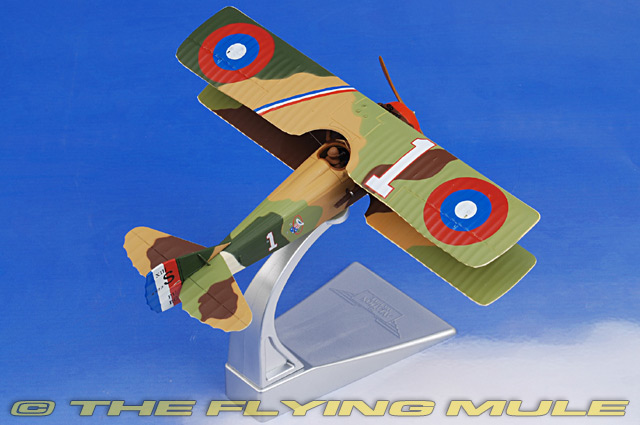
Corgi Aviation Archive Collector Series AA37903
SPAD S.XIII Diecast Model
US Army 94th Aero Sqn, Eddie Rickenbacker, 1918 | Limited Edition
2001
Pieces Worldwide |
|
| 1:48 Scale | | Length | | Width |
|---|
| SPAD S.XIII | | 5.25" | | 6.75" |
Eddie Rickenbacker is the most famous US pilot of WWI and a recipient of the Medal of Honour. Following the death of his father in the early 1900s he supported his mother by working in an automobile company. He moved into motor racing and became hugely successful, racing three times in the Indianapolis 500. When the US entered WWI he suggested a flying squadron of racing drivers. His idea was rejected but he was posted to France as an army driver. With his mechanical abilities he soon obtained a position as engineering officer at a flight training school at Issoudun from where he learnt to fly. In March 1918 he was assigned to the newly formed 94th Pursuit Squadron. Initially equipped with rather outdated Nieuports Rickenbacker nevertheless proved his abilities and on May 30th he become an Ace. By August 1918 the squadron was re-equipped with newer, faster Spads and Rickenbacker continued his success. He became commander of the 94th 'Hat in the Ring' squadron and went onto amass twenty-six aerial victories, earning him the title of America's 'Ace of Aces'.
Designed by The French aircraft company Societe pour l'Aviation et ses Derives (SPAD) as a refinement of the highly-successful SPAD S.VII, the SPAD S.XIII was first flown on April 4th, 1917. Essentially a larger version of its predecessor with a more powerful V-8 Hispano-Suiza engine, the SPAD XIII was a strongly-built wood and fabric biplane. It could reach a top speed of 135 mph-making it 10 mph faster than the new German fighters. It carried two Vickers machine guns, each with 400 rounds of ammunition, and the pilot could fire the guns separately or together. © Copyright 2003-2026 The Flying Mule, Inc.
Corgi's 1:48 scale S.XIII models are beautifully made, with simulated fabric surfaces and fine gauge wire used to represent the bracing wires passing through the banded wooden wing struts. Radiator detail is easily seen inside the engine cowling, with simulated vents and separately applied exhaust pipes on each side of the fuselage. A photo-etched metal gun sight sits between two Vickers machine guns, which are mounted in front of a detailed pilot figure and transparent windscreen. The model rests on rolling rubber tires that accurately simulate the gray color that vulcanized natural rubber takes on after prolonged exposure to sunlight.
© Copyright 2003-2013 The Flying Mule, Inc.
The Corgi "Aviation Archive" range presents highly-detailed, ready-made diecast models of military and civilian aircraft. The vast Aviation Archive range has become the standard by which all other diecast airplane ranges are judged. Each Corgi model is based on a specific aircraft from an important historical or modern era of flight, and has been authentically detailed from original documents and archival library material. Famous airplanes and aviators from both military and commercial airline aviation are all honored.
Corgi "Aviation Archive" diecast airplanes feature:
- Diecast metal construction with some plastic components.
- Realistic panel lines, antennas, access panels and surface details.
- Pad printed markings and placards that won't fade or peel like decals.
- Interchangeable extended/retracted landing gear with rotating wheels.
- Poseable presention stand to display the aircraft "in flight".
- Many limited editions with numbered certificate of authenticity.
- Detailed, hand-painted pilot and crew member figures.
- Authentic detachable ordnance loads complete with placards.
- Selected interchangeable features such as speed-brakes, opened canopies and access panels.
- Selected moving parts such as gun turrets, control surfaces and swing-wings.
© Copyright 2003-2026 The Flying Mule, Inc.