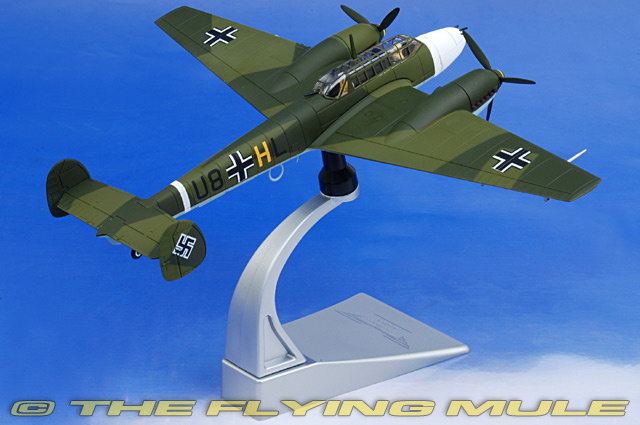
Corgi Aviation Archive Collector Series AA38505
Messerschmitt Bf 110C Diecast Model
Luftwaffe ZG 26, Hermann Brinkmann, Battle of Britain, 1940 | Limited Edition
1200
Pieces Worldwide |
|
| 1:72 Scale | | Length | | Width |
|---|
| Messerschmitt Bf 110C | | 7.25" | | 8.75" |
On 11th September 1940, Feldwebel Hermann Brinkmann and his Bordfunker Uffz. Erwin Grüschow of 2 Staffel, ZG26 were assigned as bomber escort for an attack on London. On attempting to start their Bf110 C-3 neither engine would fire and the crew quickly ran to a spare, a very early and somewhat war weary C-1, U8+HL, of 3 Staffel, ZG26. The mission proceeded and after a ferocious battle with RAF squadrons over the south east of England the Bf110s retreated to the south to await the return of the bombers. During this manoevre one of Brinkmann's engines seized up and he had to break formation. Despite diving low and heading for France he was spotted and attacked by RAF fighters. With hits to his other engine Brinkmann had no choice but to put down his stricken aircraft. U8+HL belly landed at Cobham Farm, Charing. Both crew members survived and were taken as POWs. By the end of the action the Luftwaffe had lost 25 aircraft (5 Bf110Cs from ZG26) with 60 aircrew killed or captured, whilst the RAF lost 29 fighters with 17 pilots killed.
Designed to meet a Luftwaffe requirement for a long range, multipurpose fighter, the Bf-110 was first flown on May 12th, 1936. Fast and well-armed, the Bf-110 lacked maneuverability-a flaw that became glaringly obvious during the battle of Britain, when Bf-110s suffered heavy losses and were withdrawn from battle. Redesigned Bf-110s were equipped with radar and enjoyed great success as night fighters, eventually becoming the Luftwaffe's primary aircraft in that role. Most of Germany's night fighter aces flew the Bf-110 at least once, and some of them-including top German night fighter ace Heinz-Wolfgang Schnaufer-flew it exclusively. © Copyright 2003-2026 The Flying Mule, Inc.
Corgi's 1:72 scale Bf 110 series includes the early war "C" and the late war "G" variants, with upgraded Daimler-Benz DB605 engines found in the later variant. The large bird cage canopy provides a clear view of crew figures and features crisp detailing that highlights the bullet-proof front windscreen. The nose boasts four machine guns mounted closely together with two cannon ports below. The solid metal wings feature a separately applied transparent landing light and vent with a variety of delicate aileron counter weights mounted below. The landing gear is constructed as a multi-piece subassembly and installs quick and easy for ground display.
© Copyright 2003-2013 The Flying Mule, Inc.
The Corgi "Aviation Archive" range presents highly-detailed, ready-made diecast models of military and civilian aircraft. The vast Aviation Archive range has become the standard by which all other diecast airplane ranges are judged. Each Corgi model is based on a specific aircraft from an important historical or modern era of flight, and has been authentically detailed from original documents and archival library material. Famous airplanes and aviators from both military and commercial airline aviation are all honored.
Corgi "Aviation Archive" diecast airplanes feature:
- Diecast metal construction with some plastic components.
- Realistic panel lines, antennas, access panels and surface details.
- Pad printed markings and placards that won't fade or peel like decals.
- Interchangeable extended/retracted landing gear with rotating wheels.
- Poseable presention stand to display the aircraft "in flight".
- Many limited editions with numbered certificate of authenticity.
- Detailed, hand-painted pilot and crew member figures.
- Authentic detachable ordnance loads complete with placards.
- Selected interchangeable features such as speed-brakes, opened canopies and access panels.
- Selected moving parts such as gun turrets, control surfaces and swing-wings.
© Copyright 2003-2026 The Flying Mule, Inc.