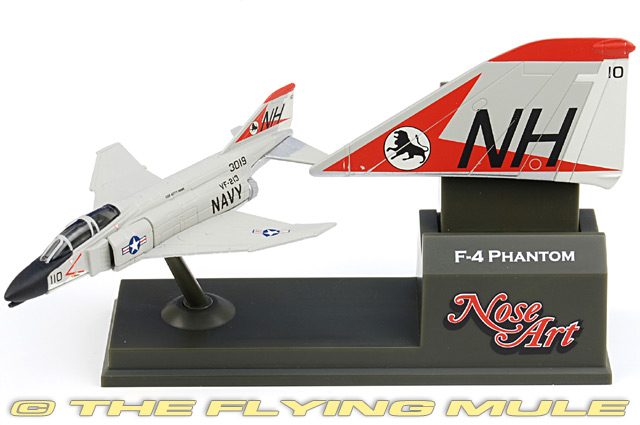
Corgi Showcase Noseart Series CS90453
McDonnell Douglas F-4C Phantom II Diecast Model
USN VF-213 Black Lions, USS Kitty Hawk, South China Sea, 1966 |
| 1:175 Scale | | Length | | Width |
|---|
| McDonnell Douglas F-4C Phantom II | | 4.25" | | 2.5" |
The McDonnell Douglas F-4 Phantom II is a two-seat, twin-engined, all-weather, long-range supersonic interceptor fighter/fighter-bomber originally developed for the U.S. Navy by McDonnell Aircraft. Proving highly adaptable, it became a major part of the air wings of the U.S. Navy, U.S. Marine Corps, and U.S. Air Force. It was used extensively by all three of these services during the Vietnam War, serving as the principal air superiority fighter for both the Navy and Air Force, as well as being important in the ground-attack and reconnaissance roles by the close of U.S. involvement in the war.
First entering service in 1960, the Phantom continued to form a major part of U.S. military air power throughout the 1970s and 1980s, being gradually replaced by more modern aircraft such as the F-15 Eagle and F-16 Fighting Falcon in the U.S. Air Force; the F-14 Tomcat and F/A-18 Hornet in the U.S. Navy; and the F/A-18 in the U.S. Marine Corps. It remained in use by the U.S. in the reconnaissance and Wild Weasel roles in the 1991 Gulf War, finally leaving service in 1996. The Phantom was also operated by the armed forces of 11 other nations. Israeli Phantoms saw extensive combat in several Arab–Israeli conflicts, while Iran used its large fleet of Phantoms in the Iran–Iraq War. Phantoms remain in front line service with seven countries, and in use as an unmanned target in the U.S. Air Force. Phantom production ran from 1958 to 1981, with a total of 5,195 built. This extensive run makes it the second most-produced Western jet fighter, behind the F-86 Sabre at just under 10,000 examples.
Designed as a fleet defense fighter for the US Navy, the F-4 Phantom was first flown on May 27, 1958. This twin-engine, long-range all-weather fighter/bomber proved highly adaptable and served in the Marine Corps and the US Air Force as well as in the Navy. During the Vietnam War, it was the principal air superiority fighter for the Navy and the Air Force and was also used for reconnaissance and ground attack. The Phantom continued to serve well into the 1970s and 1980s and even flew missions during the first Gulf War. Finally phased out by the F-14, F-16 and F/A-18, the Phantom was retired in 1996. © Copyright 2003-2026 The Flying Mule, Inc.
The Corgi "Showcase Collection Noseart Series" range presents affordable, ready-made diecast models of military aircraft paired with a scale reproduction noseart panel.
During WW2, young airmen separated from home, family, loved ones and a familiar way of life often sought ways of escaping the harsh reality of war by personalising their aircraft with what has become known as nose art. Humour, slogans, nicknames, cartoons, girls; all were used to bring a touch of light relief to their deadly day-to-day existence. The Corgi Showcase range aims to capture some of the superb works of art that adorned aircraft on all sides of the conflict. Each model is displayed alongside a diecast body panel featuring the art in colourful, large-scale detail.
Corgi "Showcase Collection Noseart Series" diecast airplanes feature:
- Diecast metal construction with some plastic components.
- Diecast metal larger scale noseart panel.
- Realistic panel lines and surface details.
- Pad printed markings that won't fade or peel like decals.
- Poseable stand to display the aircraft "in flight".
- Moving parts such as propellers, rotors and swing-wings where applicable.
- Descriptive, collectible data card.
© Copyright 2003-2026 The Flying Mule, Inc.