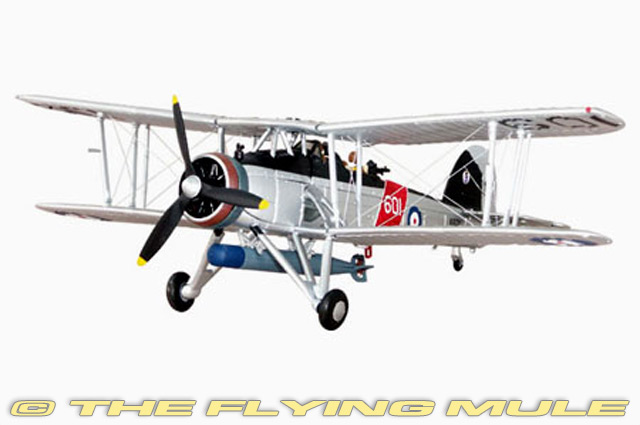
Corgi Aviation Archive Collector Series US36307
Fairey Swordfish Mk I Diecast Model
RNFAA No.811 NAS, 1938 | |
| 1:72 Scale | | Length | | Width |
|---|
| Fairey Swordfish Mk I | | 6" | | 7.75" |
The Fairey Swordfish was a torpedo bomber built by the Fairey Aviation Company and used by the Fleet Air Arm of the Royal Navy during World War II. Affectionately known as the Stringbag by its crews, it was outdated by 1939, but achieved some spectacular successes during the war, notably the destruction of the Regia Marina (the Italian Navy) in the Battle of Taranto and the famous crippling of the Bismarck. It was operated primarily as a fleet attack aircraft, however, during its later years it was also used as an anti-submarine and training craft. Designed in the 1930s, the Swordfish outlived several types intended to replace it and remained in frontline service through to the end of the war in Europe in 1945.
This spotter-reconnaissance aircraft, built by the Fairey Aviation Company for the British Royal Navy, was first flown on February 22nd, 1934. Nicknamed "Stringbag" after a housewife's string shopping bag, the Swordfish could carry an unlikely combination of loads. It could lift off a carrier deck with a standard torpedo, although this made it vulnerable to fighter attack. Its low speed and stable stance made it easy to line up for a torpedo attack, as it did against the German Bismark and on the Italian naval base at Taranto, where 21 Swordfish destroyed three battleships, a cruiser, two destroyers and other warships. © Copyright 2003-2026 The Flying Mule, Inc.
Corgi's 1:72 scale Swordfish series demonstrates this aircraft's versatility. Each release highlights its roles as a spotter-reconnaissance aircraft and a torpedo-bomber. One of the most impressive features of this model is its replicated folding wings, a feature uncommon in 1:72 scale. The wings are both pinned and keyed to insure proper alignment when fully deployed. Fine gauge wire is used to recreate the structurally significant bracing wires found between the wings and on the horizontal stabilizer. The open cockpit allows for easy viewing of the three-man crew, correctly poised for action with pivoting machine gun at the rear.
© Copyright 2003-2013 The Flying Mule, Inc.
The Corgi "Aviation Archive" range presents highly-detailed, ready-made diecast models of military and civilian aircraft. The vast Aviation Archive range has become the standard by which all other diecast airplane ranges are judged. Each Corgi model is based on a specific aircraft from an important historical or modern era of flight, and has been authentically detailed from original documents and archival library material. Famous airplanes and aviators from both military and commercial airline aviation are all honored.
Corgi "Aviation Archive" diecast airplanes feature:
- Diecast metal construction with some plastic components.
- Realistic panel lines, antennas, access panels and surface details.
- Pad printed markings and placards that won't fade or peel like decals.
- Interchangeable extended/retracted landing gear with rotating wheels.
- Poseable presention stand to display the aircraft "in flight".
- Many limited editions with numbered certificate of authenticity.
- Detailed, hand-painted pilot and crew member figures.
- Authentic detachable ordnance loads complete with placards.
- Selected interchangeable features such as speed-brakes, opened canopies and access panels.
- Selected moving parts such as gun turrets, control surfaces and swing-wings.
© Copyright 2003-2026 The Flying Mule, Inc.