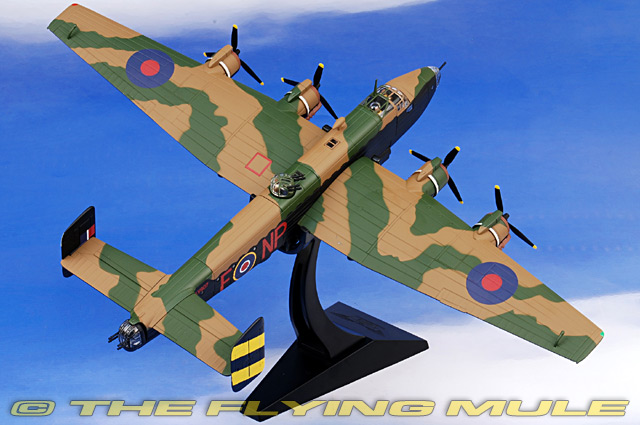
Corgi Aviation Archive Collector Series AA37204
Handley Page Halifax B.MK III Diecast Model
RAF No.158 Sqn, Friday the 13th , RAF Lisset, England, 1944 | Limited Edition
2001
Pieces Worldwide |
|
| 1:72 Scale | | Length | | Width |
|---|
| Handley Page Halifax B.MK III | | 12" | | 17.25" |
First flown from RAF Bicester on 25 October 1939, the Handley Page Halifax entered service with 35 Squadron in November 1940. The Halifax l and ll aircraft were powered by Rolls-Royce Merlin engines and the Halifax lll was powered by Bristol Hercules engines, Apart from its role as a heavy bomber, the Halifax lll and later versions also served in Coastal Command and in paratrooping and glider towing roles. Yorkshir was the home of 4 and 6 groups Bomber Command and three Halifax Squadrons were based at Elvington, 77 Squadron, and two French Air Force Squadrons, 346 (Guyenne) and 347 (Tunsie). The Yorkshire Air Museum's Halifax reconstruction is based on a section of the fuselage of Halifax ll, HR792, which carried out an emergency landing on the Isle of Lewis in 1945. The wings came from Hastings, TG536,at RAF Catterick. The reconstruction is named 'Friday the 13th" in honour of Halifax, LV907, which survived 128 operations with 158 Squadron, It is the only surviving Halifax in the world.
Designed to meet an Air Ministry specification for a twin-engined "world-wide use" medium bomber, the Handley Page Halifax first flew on September 24, 1939. This aircraft was one of the first British bomber designs to use four engines. During WWII, it flew 82,773 operations for the RAF Bomber Command, dropping 224,207 tons of bombs. It also served as a glider tug and in special operations missions such as parachute drops of arms and agents over occupied Europe. Under the RAF Coastal Command, the aircraft served in reconnaissance and meteorological roles, and in anti-submarine warfare. After the war, Halifaxes went on to serve as freighters for British airlines. © Copyright 2003-2026 The Flying Mule, Inc.
Corgi's 1:72 scale Halifax includes a complete set of crew—there is a pilot and navigator in the cockpit and gunners occupying the dorsal and rear rotating turrets. The bomb-bay doors can be configured in the open position, revealing a full load of bombs. The series includes the early Mk.II, featuring a rotating nose turret, early style dorsal mounted turret and "D" shaped vertical stabilizers, and the Mk.III, featuring an upgraded dorsal turret and a single gun mounted to a transparent nose window. Each release includes landing gear that is easy to install for ground display and an all-metal stand for in-flight display.
© Copyright 2003-2017 The Flying Mule, Inc.
The Corgi "Aviation Archive" range presents highly-detailed, ready-made diecast models of military and civilian aircraft. The vast Aviation Archive range has become the standard by which all other diecast airplane ranges are judged. Each Corgi model is based on a specific aircraft from an important historical or modern era of flight, and has been authentically detailed from original documents and archival library material. Famous airplanes and aviators from both military and commercial airline aviation are all honored.
Corgi "Aviation Archive" diecast airplanes feature:
- Diecast metal construction with some plastic components.
- Realistic panel lines, antennas, access panels and surface details.
- Pad printed markings and placards that won't fade or peel like decals.
- Interchangeable extended/retracted landing gear with rotating wheels.
- Poseable presention stand to display the aircraft "in flight".
- Many limited editions with numbered certificate of authenticity.
- Detailed, hand-painted pilot and crew member figures.
- Authentic detachable ordnance loads complete with placards.
- Selected interchangeable features such as speed-brakes, opened canopies and access panels.
- Selected moving parts such as gun turrets, control surfaces and swing-wings.
© Copyright 2003-2026 The Flying Mule, Inc.