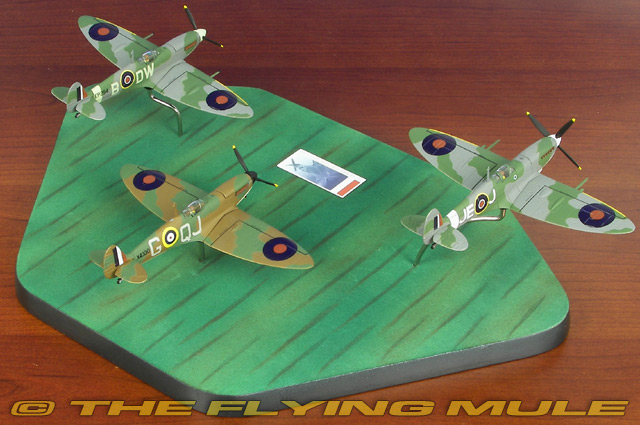
Corgi Aviation Archive Collector Series AA99189
Supermarine Spitfire Diecast Model
RAF, Johnnie Johnson, 3-Piece Set | Limited Edition
2870
Pieces Worldwide |
|
| 1:72 Scale | | Length | | Width |
|---|
| Supermarine Spitfire | | 5" | | 6.25" |
The most famous and most successful Spitfire Ace of World War II was undoubtedly Johnnie Johnson, remarkable also as one of the few to fly all three of the most recognized of Spitfire variants. Air Vice Marshal James Edgar "Johnnie" Johnson CB, CBE, DSO and two Bars, DFC and Bar (9 March 1915 - 30 January 2001) was an RAF pilot who during World War II shot down 38 Luftwaffe aircraft, thus becoming the British flying ace with the most "kills" during the war. Presented here on a plinth to celebrate the 70th Anniversary of his famous mount, it was the MkIX which saw him at his most successful but both the earlier Mark I and Mark VB were also part of the Legend.
Designed by R.J.Michell to meet a British Air Ministry specification, the Supermarine Spitfire first flown on March 5th, 1936. With its combination of beautiful fighter design, the excellent performance of its Rolls-Royce Merlin powerplant and firepower provided by twin cannons and four machine guns, the Spitfire became an unrivaled symbol of victory. The Spitfire had 40 major variants and was built in greater numbers than any other British aircraft of the time. It flew operationally on every front between 1939 and 1945 and was engaged in every one of the Royal Air Force's major actions. © Copyright 2003-2026 The Flying Mule, Inc.
Corgi's 1:72 scale Spitfire series includes many versions of this famous aircraft, from Mk I to the Griffon-engined variants with five bladed propellers. The characteristic under-wing mounted pitot tube and offset radiator and oil cooler ducts are mounted below the solid metal wings with a variety of machine guns and cannons. The all metal horizontal stabilizers and rudder feature simulated fabric stretched control surfaces. On some releases, the top engine cowing is removable to reveal engine detail engine and exhaust detail. The model is constructed almost entirely of solid diecast metal and feels surprisingly heavy in this scale.
© Copyright 2003-2025 The Flying Mule, Inc.
The Corgi "Aviation Archive" range presents highly-detailed, ready-made diecast models of military and civilian aircraft. The vast Aviation Archive range has become the standard by which all other diecast airplane ranges are judged. Each Corgi model is based on a specific aircraft from an important historical or modern era of flight, and has been authentically detailed from original documents and archival library material. Famous airplanes and aviators from both military and commercial airline aviation are all honored.
Corgi "Aviation Archive" diecast airplanes feature:
- Diecast metal construction with some plastic components.
- Realistic panel lines, antennas, access panels and surface details.
- Pad printed markings and placards that won't fade or peel like decals.
- Interchangeable extended/retracted landing gear with rotating wheels.
- Poseable presention stand to display the aircraft "in flight".
- Many limited editions with numbered certificate of authenticity.
- Detailed, hand-painted pilot and crew member figures.
- Authentic detachable ordnance loads complete with placards.
- Selected interchangeable features such as speed-brakes, opened canopies and access panels.
- Selected moving parts such as gun turrets, control surfaces and swing-wings.
© Copyright 2003-2026 The Flying Mule, Inc.