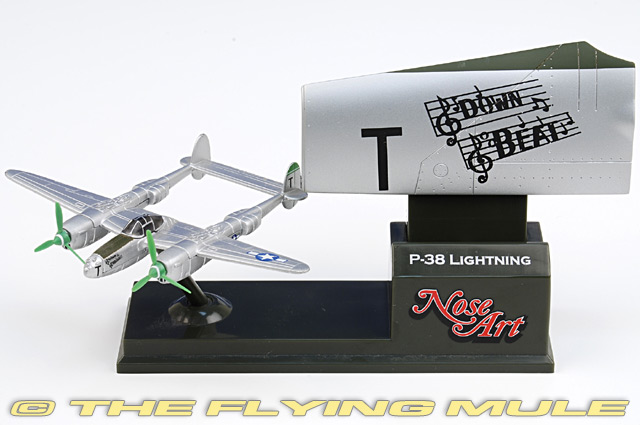
Corgi Showcase Noseart Series CS90366
Lockheed P-38J Lightning Diecast Model
USAAF 8th FG, 80th FS, "Down Beat", Dick Bong, April 1st 1944 |
| 1:147 Scale | | Length | | Width |
|---|
| Lockheed P-38J Lightning | | 3" | | 4.25" |
80th FS legend suggest that Dick Bong was flying this machine when he broke Eddie Rickenbacker's 26-kill World War 1 ace record on 12 April 1944. Bong downed three Ki-43 'Oscars' over Hollandia to boost his tally to 28. However, others, including the aircraft's crew chief, Sam Scher, state that it was only ever flown by Bong once, on 1 April 1944. The ace complimented Scher on his maintenance of DOWNBEAT.
During WW2, young airmen separated from home, family, loved ones and a familiar way of life often sought ways of escaping the harsh reality of war by personalising their aircraft with what has become known as nose art. Humour, slogans, nicknames, cartoons, girls; all were used to bring a touch of light relief to their deadly day-to-day existence. The Corgi Showcase range aims to capture some of the superb works of art that adorned aircraft on all sides of the conflict. Each model is displayed alongside a diecast body panel featuring the art in colourful, large-scale detail.
Designed to meet a USAAC requirement for a high-performance fighter, the P-38 Lightning was first flown on January 27th, 1939. The easily recognizable P-38 had twin-booms, twin turbo-supercharged engines, a central pod for the pilot, contra-rotating propellers and tricycle landing gear. Its roles included dive bombing, level bombing, ground strafing and photo reconnaissance. When equipped with drop tanks it was also flown as a long-range escort fighter. The Lightning's armament was clustered in the nose of the plane, which gave the pilot a direct line of site to the target and also gave the weapons a "buzz saw" effect that was useful for strafing. © Copyright 2003-2026 The Flying Mule, Inc.
The Corgi "Showcase Collection Noseart Series" range presents affordable, ready-made diecast models of military aircraft paired with a scale reproduction noseart panel.
During WW2, young airmen separated from home, family, loved ones and a familiar way of life often sought ways of escaping the harsh reality of war by personalising their aircraft with what has become known as nose art. Humour, slogans, nicknames, cartoons, girls; all were used to bring a touch of light relief to their deadly day-to-day existence. The Corgi Showcase range aims to capture some of the superb works of art that adorned aircraft on all sides of the conflict. Each model is displayed alongside a diecast body panel featuring the art in colourful, large-scale detail.
Corgi "Showcase Collection Noseart Series" diecast airplanes feature:
- Diecast metal construction with some plastic components.
- Diecast metal larger scale noseart panel.
- Realistic panel lines and surface details.
- Pad printed markings that won't fade or peel like decals.
- Poseable stand to display the aircraft "in flight".
- Moving parts such as propellers, rotors and swing-wings where applicable.
- Descriptive, collectible data card.
© Copyright 2003-2026 The Flying Mule, Inc.