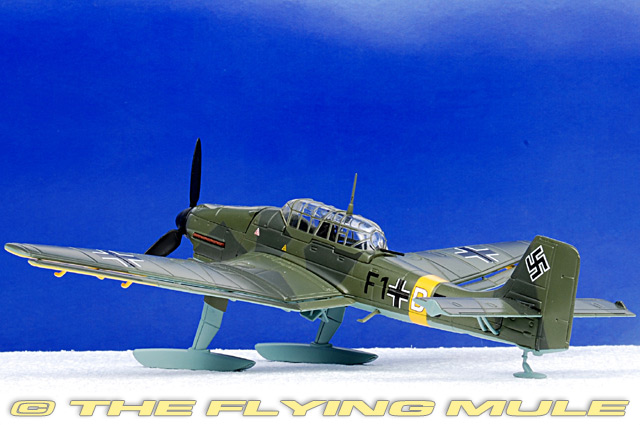
Corgi Flying Mule Collection US32512
Junkers Ju 87B-2/U4 Stuka Diecast Model
Luftwaffe III./StG 77, "F1+DJ", Eastern Front, 1942 | Limited Edition
1000
Pieces Worldwide |
|
| 1:72 Scale | | Length | | Width |
|---|
| Junkers Ju 87B-2/U4 Stuka | | 6.25" | | 7.5" |
The Junkers Ju 87 Stuka was the best-known dive bomber of World War II, with more than 6,000 entering service between 1936 and 1944. The Ju 87 was sturdy and accurate, but it had little defensive armor, poor maneuverability and a top speed of just 199 mph. Despite being very vulnerable to attack from allied fighters, the Ju 87 nevertheless proved highly successful in the German "Blitzkrieg" campaigns, and remains as one of the most enduring images of the Nazi air war.
The Ju 87B entered development in August 1938 in an effort to correct the performance problems of its predecessor. The primary upgrade to the Ju 87B was the Junkers Jumo 211 A engine, which had 1,100 hp (compared to just 680 hp in the Ju87A-2's Jumo 210 Da). This gave the Ju 87B the power it needed to be an effective dive-bomber.
The Ju 87B-2, which had the slightly more powerful 1,200 hp Jumo 211 Da and other small improvements such as a new propeller, was also fitted with modification kits such as ski landing gear designed for winter operations in the Soviet Union. The Germans hoped the thus-equipped Ju 87B-2/U4 would contribute to the success of the Germans' assault on Moscow, but the most severe winter weather in 20 years all but halted the operation. The Ju 87 was not designed to cope with subzero temperatures, and fires had to be lighted beneath the planes' engines to help start them. The aircraft mechanics' tools froze to their hands, yet the few heaters the Germans possessed had to be employed to keep the aircraft engines from freezing. Worse, the Ju 87B-2/U4's heavy skis had a negative influence on the aircraft's performance, all of which combined to ensure the failure of Hitler's plan to conquer the Soviet Union.
Designed to function as a close support aircraft, the Ju 87 was first flown on September 17th, 1935. The Ju 87 had an innovative design that included automatic dive brakes under each wing-a feature that protected against the consequences of pilot blackout by ensuring recovery from an attack dive. Crewed by a pilot and rear gunner, the Ju 87 had twin 37mm cannons and a bomb that swung away from the propeller on an elongated U-shaped crutch. Its inverted gull wings improved pilot-to-ground visibility, gave the undercarriage a shorter height and made the Ju 87 instantly recognizable to its enemies. © Copyright 2003-2026 The Flying Mule, Inc.
Corgi's 1:72 scale Stukas faithfully replicate the gull-wing or "cranked" wing pattern, which with the spatted main gear was one of the most notable and unusual features of this aircraft. Delicately assembled dive-brakes can be seen be seen beneath each wing. A 250kg bomb is mounted to the U-shaped crutch below the fuselage. The top engine cover can be removed to reveal the inverted Junkers Jumo 211D engine with the correct main engine support frames. Additional features include all-metal braced elevators, engine radiator detail, slotted ailerons and flaps and a rearward-facing machine gunner manning the M15 machine gun.
© Copyright 2003-2013 The Flying Mule, Inc.
The Corgi "Flying Mule Collection" range presents highly-detailed, ready-made diecast models of military aircraft. Models in this range are produced in limited quantities with individually numbered certificates as part of the Corgi Aviation Archive Collector Series. They are highly collectible and have become very desirable among Corgi Aviation Archive collectors.
Corgi "Flying Mule Collection" diecast airplanes feature:
- Diecast metal construction with some plastic components.
- Realistic panel lines, antennas, access panels and surface details.
- Pad printed markings and placards that won't fade or peel like decals.
- Interchangeable extended/retracted landing gear with rotating wheels.
- Poseable presention stand to display the aircraft "in flight".
- Numbered certificate of authenticity.
- Commissioned box artwork.
- Detailed pilot and crew member figures.
- Authentic detachable ordnance loads complete with placards.
- Selected interchangeable features such as speed-brakes, opened canopies and access panels.
- Selected moving parts such as gun turrets, control surfaces and swing-wings.
© Copyright 2003-2026 The Flying Mule, Inc.