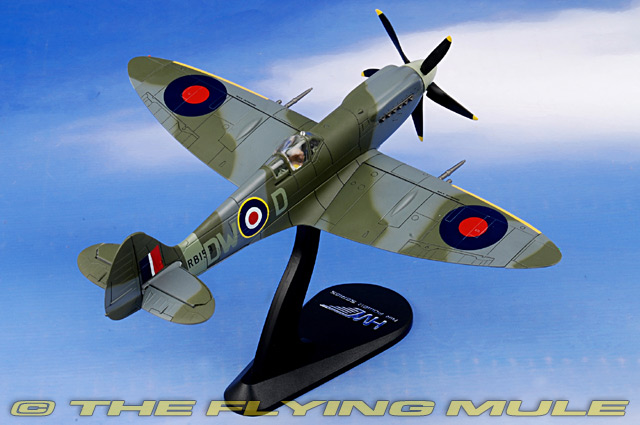
Hobby Master 1:48 Air Power Series HA7102
Supermarine Spitfire Mk XIV Diecast Model
RAF No.610 Sqn, Richard Newbery, RAF West Malling, England, 1944 | Limited Edition
1800
Pieces Worldwide |
|
| 1:48 Scale | | Length | | Width |
|---|
| Supermarine Spitfire Mk XIV | | 8.25" | | 9.25" |
610 Squadron formed at Hooton Park in Cheshire in 1936 as part of the Royal Auxiliary Air Force. January 1939 saw them re-designated as an RAF fighter squadron. In 1944 the 610 was the first to receive the new Spitfire XIVs. The new Griffon powered aircraft arrived when the V-1 rockets started and used their speed to chase down and destroy them. The 610 Squadron destroyed 50 V-1s with 1/5 going to S/L Richard A. Newbery DFC flying DW-D RB159. Newbery was C/O of 610 Squadron January 1944 – February 1945. With long range fuel tanks 610 flew missions over Germany. 610 Squadron motto "Alifero tollitur axe ceres"; which translates as "Ceres rising in a winged chariot". Ceres being the Roman Goddess of Wheat, a reference to Chester's Agricultural sector. Its badge contained the image of a sheaf of wheat.
Designed by R.J.Michell to meet a British Air Ministry specification, the Supermarine Spitfire first flown on March 5th, 1936. With its combination of beautiful fighter design, the excellent performance of its Rolls-Royce Merlin powerplant and firepower provided by twin cannons and four machine guns, the Spitfire became an unrivaled symbol of victory. The Spitfire had 40 major variants and was built in greater numbers than any other British aircraft of the time. It flew operationally on every front between 1939 and 1945 and was engaged in every one of the Royal Air Force's major actions. © Copyright 2003-2026 The Flying Mule, Inc.
Hobby Master's 1:48 scale late model Spitfire is cleverly designed to provide the collector with a reasonably-priced, top-quality product with just the right number of features. The canopy is removable for an unobstructed view of the instrument panel with pad-printed gauges and seat. The all-metal five-bladed propeller spins freely and the rudder and elevators are movable. The near-solid metal wing features hinged metal landing gear with integrated metal gear doors and radiator ducts with inside core details seen both front and back. Variants include the Mk.XIV with Large flat back blister canopy and the Mk. XIX with standard Malcolm hood canopy.
© Copyright 2003-2014 The Flying Mule, Inc.
The Hobby Master "1:48 Air Power Series" range presents detailed, ready-made diecast models of military aircraft.
Hobby Master "1:48 Air Power Series" diecast airplanes feature:
- Diecast metal construction with some plastic components.
- Realistic panel lines, antennas, access panels and surface details.
- Pad printed markings and placards that won't fade or peel like decals.
- Opening canopies, revealing detailed cockpit interiors.
- Interchangeable extended/retracted landing gear.
- Presentation stand to display the aircraft "in flight".
- Authentic detachable ordnance loads complete with placards.
- Accurately detailed underside with concealed screwheads.
© Copyright 2003-2026 The Flying Mule, Inc.