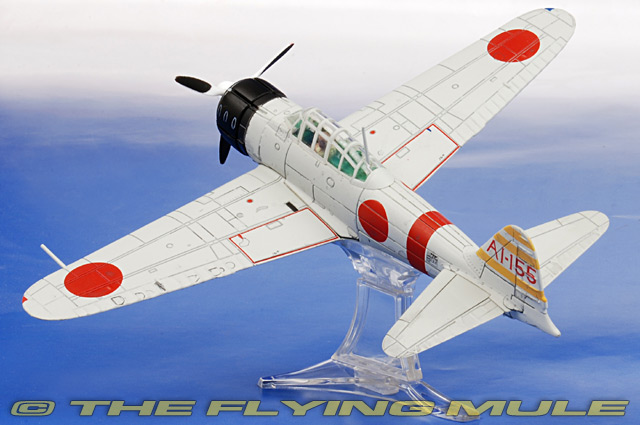
Unimax Forces of Valor 85032
Mitsubishi A6M2 Zero-Sen/Zeke Diecast Model
IJNAS Akagi Flying Group, AI-155, Shigeru Itaya, IJN Carrier Akagi, Pearl Harbor, December 7th 1941 |
| 1:72 Scale | | Length | | Width |
|---|
| Mitsubishi A6M2 Zero-Sen/Zeke | | 5" | | 6" |
On December 7th, 1941 at 7:48 a.m. Hawaiian Time, the US Naval base at Pearl Harbor was pre-emptively attacked by the Empire of Japan to prevent the US Pacific Fleet from interfering with planned Japanese military actions in Southeast Asia. The attack was carried out by 353 fighters, bombers and torpedo planes, launched in two waves from a task force of six aircraft carriers (Akagi, Kaga, Soryu, Hiryu, Shokaku, and Zuikaku) northwest of Hawaii. The damage inflicted was massive. All eight U.S. Navy battleships were damaged, with four being sunk, in addition to damaging or sinking three cruisers, three destroyers, an anti-aircraft training ship and one minelayer. 188 U.S. aircraft were destroyed; 2,402 Americans were killed and 1,282 wounded. Japanese losses were light: 29 aircraft and five midget submarines lost, and 65 servicemen killed or wounded. One Japanese sailor was captured. The attack came as a profound shock to the American people and led directly to the American entry into World War II in both the Pacific and European theaters. The following day (December 8), the United States declared war on Japan. There were numerous historical precedents for unannounced military action by Japan. However, the lack of any formal warning, particularly while negotiations were still apparently ongoing, led President Franklin D. Roosevelt to proclaim December 7, 1941, "a date which will live in infamy".
First flown in April, 1939, the A6M Zero-Sen was the Allies' main opponent in the Pacific and the most famous symbol of Japanese air power during World War II. This carrier-based fighter, designed with a low-monoplane wing and armed with a formidable array of two 20mm cannons and two 7.7mm machine guns, proved capable of handling any of the Allies' aircraft. It wasn't until the Allies studied a captured Zero that they were able to identify and exploit weaknesses such as minimal pilot and fuel tank protection. Zeros became infamous for Kamikaze attacks, in which pilots would intentionally crash explosion-laden aircraft into Allied ships. © Copyright 2003-2026 The Flying Mule, Inc.
Forces of Valor's 1:72 scale A6M Zero is constructed almost entirely of diecast metal, with only the smallest amount of plastic used. The solid metal wing has simulated fabric stretched control surfaces. The two-piece engine cowling is removable, providing a completely unobstructed view of the masterfully replicated two-row 14 cylinder Nakajima Sakae engine. The center mounted external fuel tank is removable, and the main landing gear is constructed as a complete subassembly for easy ground configuration. The large birdcage canopy allows for easy viewing of the hand-painted pilot figure.
© Copyright 2003-2013 The Flying Mule, Inc.
The Unimax "Forces of Valor" range presents affordable, ready-made diecast models of military aicraft.
Unimax "Forces of Valor" diecast airplanes feature:
- Diecast metal construction with some plastic components.
- Realistic panel lines, antennas, access panels and surface details.
- Pad printed markings and placards that won't fade or peel like decals.
- Interchangeable extended/retracted landing gear.
- Fixed display stand to display the aircraft "in flight".
- Detailed pilots and crew members.
- Authentic detachable ordnance loads complete with placards.
© Copyright 2003-2026 The Flying Mule, Inc.