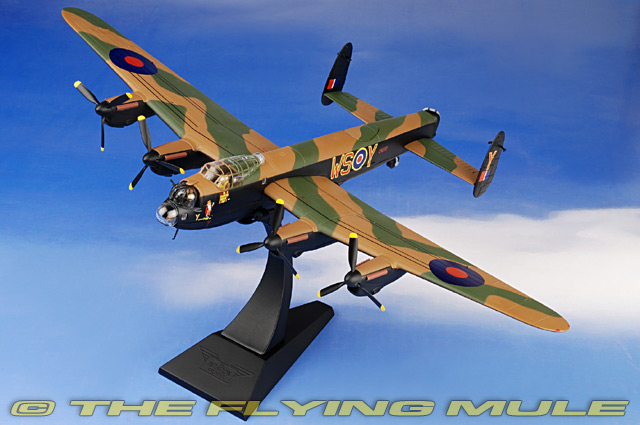
Corgi Aviation Archive Collector Series AA32618
Avro Lancaster B.Mk I Diecast Model
RAF No.9 Sqn, LM220 "Getting Younger Everyday" , U-Boat Pens Raid, January 1945, w/Tallboy bomb |
| 1:72 Scale | | Length | | Width |
|---|
| Avro Lancaster B.Mk I | | 11.75" | | 17" |
As the war neared its end the Germans were concealing more and more of their important facilities underground in heavily fortified and defended positions with targets such as U-boat pens being protected by thick concrete roofs. As early as 1941 the great engineer Barnes Wallis had begun design on a bomb that would be able to penetrate deep underground and then explode. He called it his ‘Earthquake’ bomb, this later became the prototype of the ‘Tallboy’ bomb. Weighing 12,000lbs, the Tallboys were first used against the Saumur railway tunnel in Western France and went on to prove their effectiveness against U-Boat pens, bunkers and the famous German battleship Tirpitz. This particular machine belonged to 9 Squadron RAF, one of only two squadrons that dropped Tallboys. On the night of the 11th January 1945 this machine helped penetrate 3.5M of concrete above the U-Boat pens at Bergen, destroying the intended target.
Designed to meet a specification for a new generation of "worldwide use" medium bombers, the Avro Lancaster was first flown on January 8, 1941. The design of the Lancaster evolved from an unsuccessful two-engine aircraft called the Manchester. The heavier Lancaster had four engines and an extensive bomb bay, with later versions capable of carrying 22,000 lb bombs. Used primarily as a night bomber, the Lancaster was a versatile aircraft that became most famous for its role in the 1943 "Dam Buster" raids on Germany's Ruhr Valley dams. Between 1942 and 1945, Lancasters flew 156,000 sorties, dropping 608,612 tons of bombs on enemy targets. © Copyright 2003-2025 The Flying Mule, Inc.
Corgi's 1:72 scale Lancaster series includes many variants, all of which are constructed using a large number of diecast metal components. All crew positions are occupied—there is a pilot and navigator in the cockpit, a bombardier lying prone behind the perspex nose cupola and gunners occupying the rotating turrets. The overall presentation of this model has led to its popularity, from the accurate recreation of the Lancaster's distinctive airframe to the simulated fabric control surfaces with photo-etched metal aileron trim linkages and twin oval rudders. A heavily constructed all-metal display stand is included to support this massive aircraft for in-flight display.
© Copyright 2003-2017 The Flying Mule, Inc.
The Corgi "Aviation Archive" range presents highly-detailed, ready-made diecast models of military and civilian aircraft. The vast Aviation Archive range has become the standard by which all other diecast airplane ranges are judged. Each Corgi model is based on a specific aircraft from an important historical or modern era of flight, and has been authentically detailed from original documents and archival library material. Famous airplanes and aviators from both military and commercial airline aviation are all honored.
Corgi "Aviation Archive" diecast airplanes feature:
- Diecast metal construction with some plastic components.
- Realistic panel lines, antennas, access panels and surface details.
- Pad printed markings and placards that won't fade or peel like decals.
- Interchangeable extended/retracted landing gear with rotating wheels.
- Poseable presention stand to display the aircraft "in flight".
- Many limited editions with numbered certificate of authenticity.
- Detailed, hand-painted pilot and crew member figures.
- Authentic detachable ordnance loads complete with placards.
- Selected interchangeable features such as speed-brakes, opened canopies and access panels.
- Selected moving parts such as gun turrets, control surfaces and swing-wings.
© Copyright 2003-2025 The Flying Mule, Inc.