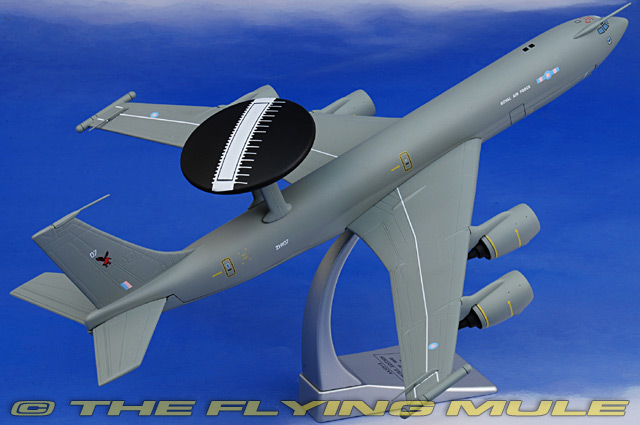
Corgi Aviation Archive Collector Series AA32915
Boeing E-3D Sentry Diecast Model
RAF Nos.8 and 23 Sqns | Limited Edition
1600
Pieces Worldwide |
|
| 1:144 Scale | | Length | | Width |
|---|
| Boeing E-3D Sentry | | 12.75" | | 12.25" |
The Boeing E-3 Sentry is the West's principal AWACS ( airborne warning and control system) platform. Using the airframe of a Boeing 707-320B airliner and a massive payload of radar and electronic sensors, the E-3/AWACS is a flying headquarters for command, control, communications and intelligence. It is employed near a combat zone to monitor aircraft and missiles and to direct friendly warplanes. On a typical mission, an E-3, which has an unfuelled endurance of 11 hours, routinely refuels and stays aloft for up to 18 hours, carrying a crew of 20 including 16 mission specialists such as weapons controllers, radar operators and communications specialists. Heart of the AWACS system is its Westinghouse AN/APY Overland Downlook Radar (ODR) which, with other sensors and instrumentation, is mounted in a saucer-like rotodome mounted on two struts above the rear fuselage. In operation, the dome rotates six times per minute, the radar being capable of tracking up to 600 low-flying aircraft. In the early 1980s there was an urgent requirement for the Royal Air Force to replace its aging Avro Shakleton airborne Early Warning variants. It had been intended to operate an AEW variant of the Nimrod maritime anti-submarine patrol aircraft, but continual problems encountered with the radar meant that the delivery dates kept slipping back until the second half of 1987 at the earliest, so the Defense Minister announced that the program had been terminated on 18 December 1986 and that six E-3As would be ordered, to enter service and replace the Shakletons from midnight on 30th June 1991. The RAF order was increased to 7 Sentry aircraft, which operate in the airborne surveillance and control role. The aircraft are based at RAF Waddington, where they are operated by Nos 8 and 23 Squadrons as the UK's contribution to the NATO Airborne Early Warning and Control System (AWACS) role. The Sentry is based on the commercial Boeing 707 aircraft, which has been extensively modified and updated to accommodate modern, high-tech mission systems. Endurance is approximately 10 hours (over 5,750 miles/9,250 km), although this can be extended using either drogue or boom air-to-air refueling. The Sentry is the only aircraft in the RAF's inventory capable of air-to-air refueling by both the American 'flying-boom' system and the RAF's 'probe-and-drogue' method. ZH107 was not only the last Sentry built for the RAF but was also the very last Boeing 707 airframe derivative built by Boeing at Seattle, Washington. It was delivered on 21 August 1991 over 33 years since the first Boeing 707 was delivered.
Designed to meet a USAF requirement for an AWACS (Airborne Warning And Control System) aircraft, the E-3 was first flown on May 25th, 1976. The design uses the basic airframe of the commerical 707-320B and adds a 30 foot diameter rotating radar dome atop a pair of 11 foot tall struts. The radar system is capable of detecting and tracking low-flying targets at a range of 250 miles or mideium to high-altitude targets as far away as 400 miles. Onboard data-processing systems present Console operators with a wide range of information, enabling them to protect and guide friendly forces on the battlefield. © Copyright 2003-2025 The Flying Mule, Inc.
Corgi's 1:144 scale Boeing 707 is large in this scale and features near-solid diecast construction. This model's sleek tubular shaped fuselage and wonderfully sculpted nose has pad-printed windows and doors that do not interrupt the lines of the aircraft. Each release features either the engine nacelles of the early JT3 engines or the later JT4 with turbo fan details clearly seen inside each intake. Certain releases are equipped with individually applied engine noise suppression "hush" kits at each exhaust. Configuration for ground display is easy with landing gear that installs quickly and with air stairs (on most releases) for enhanced ground display (see photos).
© Copyright 2003-2013 The Flying Mule, Inc.
The Corgi "Aviation Archive" range presents highly-detailed, ready-made diecast models of military and civilian aircraft. The vast Aviation Archive range has become the standard by which all other diecast airplane ranges are judged. Each Corgi model is based on a specific aircraft from an important historical or modern era of flight, and has been authentically detailed from original documents and archival library material. Famous airplanes and aviators from both military and commercial airline aviation are all honored.
Corgi "Aviation Archive" diecast airplanes feature:
- Diecast metal construction with some plastic components.
- Realistic panel lines, antennas, access panels and surface details.
- Pad printed markings and placards that won't fade or peel like decals.
- Interchangeable extended/retracted landing gear with rotating wheels.
- Poseable presention stand to display the aircraft "in flight".
- Many limited editions with numbered certificate of authenticity.
- Detailed, hand-painted pilot and crew member figures.
- Authentic detachable ordnance loads complete with placards.
- Selected interchangeable features such as speed-brakes, opened canopies and access panels.
- Selected moving parts such as gun turrets, control surfaces and swing-wings.
© Copyright 2003-2025 The Flying Mule, Inc.