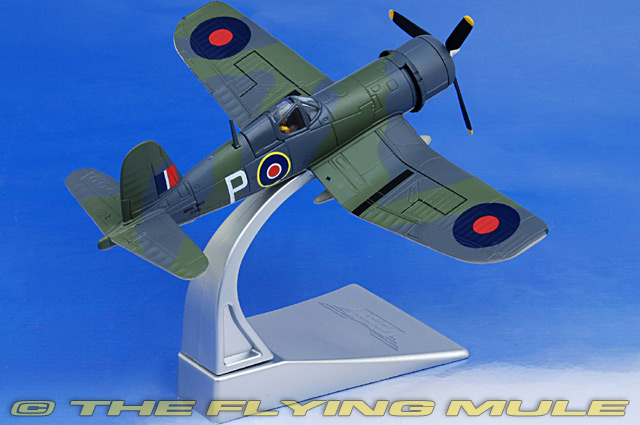
Corgi Aviation Archive Collector Series AA33015
Vought F4U Corsair Diecast Model
RNFAA No.1842 NAS, HMS Formidable, Operation Goodwood, August 1944 | Limited Edition
1500
Pieces Worldwide |
|
| 1:72 Scale | | Length | | Width |
|---|
| Vought F4U Corsair | | 5.5" | | 6.75" |
A total 2,012 Corsairs saw service with the Fleet Air Arm during WW2 and the immediate post-war period. Royal Navy Corsairs all had 41cm clipped from their wing-tips which enabled below-deck storage on British carriers which were smaller than the American carriers for which the Corsair was originally designed. 1842 Sqn was formed in February 1944 and shipped to the USA to train on Corsairs. When training was completed the squadron returned to the UK and embarked in HMS Formidable. In August 1944 along with Indefatigable, Furious, Nabob and Trumpeter, Formidable and 1842 Sqn took part in Operation Goodwood, a series of four attacks upon the German Battleship Tirpitz. The infamous German battleship, which was moored in a Norwegian Fjord, posed a serious threat to convoys sailing from the UK to Russia and had already been attacked on a number of occasions. During the Goodwood attacks the Corsairs attacked flak positions and JT590 received serious damage to the starboard elevator but returned to the carrier and landed safely.
Designed to meet a US Navy requirement for a single-seat carrier based fighter, the F4U was first flown on May 29th, 1940. This versatile aircraft saw service with both the Navy and Marine Corps in WW II and in the Korean War. During its lifetime, the Corsair underwent numerous improvements such as a lengthened fuselage, a high visibility bubble-top canopy and folding inverted gull wings that provided clearance for a large propeller. Its performance advantage, 400 mph capability, the ability to withstand punishment and six .50 Browning machine guns made the F4U a devastating weapon against aircraft, ground targets and ships. © Copyright 2003-2026 The Flying Mule, Inc.
Corgi's 1:72 scale Corsair series includes the early "bird cage" canopy variants and the mid- and late-war variants, which had a taller and wider clear-view canopy with only two frames. This model is made almost entirely of diecast metal with only the smallest amount of plastic used in its construction. The solid metal wing features oil cooler vents, machine gun ports on the leading edge and a pair of removable external fuel tanks mounted below. The all-metal horizontal stabilizers and rudder feature simulated fabric stretched control surfaces. The landing gear is robust in design and installs quickly and easily for ground display.
© Copyright 2003-2013 The Flying Mule, Inc.
The Corgi "Aviation Archive" range presents highly-detailed, ready-made diecast models of military and civilian aircraft. The vast Aviation Archive range has become the standard by which all other diecast airplane ranges are judged. Each Corgi model is based on a specific aircraft from an important historical or modern era of flight, and has been authentically detailed from original documents and archival library material. Famous airplanes and aviators from both military and commercial airline aviation are all honored.
Corgi "Aviation Archive" diecast airplanes feature:
- Diecast metal construction with some plastic components.
- Realistic panel lines, antennas, access panels and surface details.
- Pad printed markings and placards that won't fade or peel like decals.
- Interchangeable extended/retracted landing gear with rotating wheels.
- Poseable presention stand to display the aircraft "in flight".
- Many limited editions with numbered certificate of authenticity.
- Detailed, hand-painted pilot and crew member figures.
- Authentic detachable ordnance loads complete with placards.
- Selected interchangeable features such as speed-brakes, opened canopies and access panels.
- Selected moving parts such as gun turrets, control surfaces and swing-wings.
© Copyright 2003-2026 The Flying Mule, Inc.