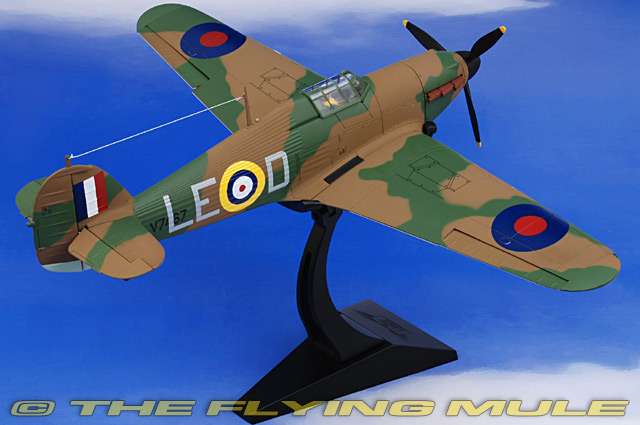
Corgi Aviation Archive Collector Series AA35505
Hawker Hurricane Mk II Diecast Model
RAF No.242 Sqn, Douglas Bader, RAF Coltishall, England, Battle of Britain, 1940 | Limited Edition
2270
Pieces Worldwide |
|
| 1:32 Scale | | Length | | Width |
|---|
| Hawker Hurricane Mk II | | 12" | | 15" |
Probably the most widely- known participant in the Battle of Britain, Bader was born in St. John's Wood, London on February21st 1910. In 1928 he won a prize cadetship to RAF College, Cranwell and began the course therein September. After passing out in July 1930, Bader was commissioned and on August the 25th he was posted to 23 Squadron in the pairs acrobatic competition at the Hendon Air Display, when the squadron won for the third year running. On December the 14th 1931 Bader crashed in a Bulldog, after attempting a roll at a very low level. Miraculously he was not killed but lost both of his legs, the right one above the knee, and the left below. After being, fitted with artificial limbs, Bader remained in the RAF but most unhappily because he was not allowed to fly. He was retired by the Air Ministry on April 30th 1933, following the outbreak of war. Bader became increasingly insistent about rejoining the RAF in a flying capacity. Finally, on October the 18th 1939, he went to CFS. Upavon for a flying test, which was conducted by Squadron Leader RHA Leigh (qv) Bader passed the test and was re-employed as a regular officer on November 26th. After a refresher course at Upavon, he joined 19 Squadron at Duxford on February the 7th 1940, with the rank of Flying Officer. In March he was promoted to Flight Lieutenant and posted to 222 Squadron, also at Duxford, as a Flight Commander. On June 1st Bader scored his first victory, when he shot down a Bf 109 near Dunkirk and shared in the probable destruction of a He111. In early July Bader was promoted to Acting Squadron Leader and given command of 242 Squadron at Coltishall, a unit made up mainly of Canadian pilots. Morale was low and discipline was lax when Bader set himself the task of bringing 242 back to a good operational standard and this is when he flew this famous Hurricane. On July the 11th 1940 Bader shot down a Do 17 into the sea off Cromer. He sent another Do 17 into the sea near Yarmouth on August 21st and claimed two Bf 110s destroyed on the 30th. Bader claimed two Bf 110s destroyed on September 7th, a Do 17 shot down and two others damaged on the 9th, another Do 17 destroyed and two mor3e damages on the 15th, a JU 88 and a Do 17 destroyed on the 18th and a Bf 109 shot down and probably a second on the 27th. Bader's final victory with 242 was a shared Ju88 on January the 22nd 1941. In June he began to add to his victories in sweeps over France, on June 21st a Bf 109, on the 26th a Bf 109 and another shared and on July 2nd another Bf 109 and a second one damaged. On the 4th Bader probably destroyed a Bf 109, on the 6th he shot one down, on the 9th probably destroyed one and damaged a second, on the 10th destroyed one and probably a second, on the 12th destroyed one and damaged three others, on the 19th destroyed one, probably a second and shared in the destruction of a third. Bader shared another Bf 109 and damaged a second on the 21st and damaged another on the 23rd. He led the Wing on August 9th to escort bombers to Bethune. From the start things went wrong and he found himself alone and involved with several Bf 109s. In the ensuing combat, south of Le Touquet, he claimed a Bf 109 destroyed and probably a second before he was himself shot down. Bader baled himself out and was captured on landing, minus his right artificial leg. For the Germans he was a difficult prisoner and he eventually finished up in Colditz Castle. He was released from there on April 14th 1945.
Based on the Fury biplane and designed by Sydney Camm as a monoplane fighter, the Hurricane was first flown on November 6th, 1935. With its wide-set landing gear, easy handling, reliability, and stable gun platform, the Hurricane was suitable for a variety of different roles such as intruder, ground strafing and night fighter. Steel-tube construction meant cannon shells could pass right through the wood and fabric covering without exploding. The Hurricane underwent many modifications during its lifetime, including an upgraded Merlin engine and interchangeable multi-purpose wings, staging twelve 7.7mm guns and two 40mm anti-tank guns and carrying two 500lb bombs. © Copyright 2003-2025 The Flying Mule, Inc.
Corgi's 1:32 scale Hurricane is a large model loaded with features. . All of the control surfaces are movable, including the radiator cowl and the inboard split flaps, which reveal inner details when deployed. The landing gear is hinged and easy to position for ground or in-flight display. The upper portion of the engine cowling is removable, revealing a masterfully rendered V-12 Merlin engine, and the cockpit interior and pilot figure are easily viewed with the canopy open or closed. Each release has either four machine gun ports or two Hispano cannon barrels on each side of the wing's leading edge.
© Copyright 2003-2013 The Flying Mule, Inc.
The Corgi "Aviation Archive" range presents highly-detailed, ready-made diecast models of military and civilian aircraft. The vast Aviation Archive range has become the standard by which all other diecast airplane ranges are judged. Each Corgi model is based on a specific aircraft from an important historical or modern era of flight, and has been authentically detailed from original documents and archival library material. Famous airplanes and aviators from both military and commercial airline aviation are all honored.
Corgi "Aviation Archive" diecast airplanes feature:
- Diecast metal construction with some plastic components.
- Realistic panel lines, antennas, access panels and surface details.
- Pad printed markings and placards that won't fade or peel like decals.
- Interchangeable extended/retracted landing gear with rotating wheels.
- Poseable presention stand to display the aircraft "in flight".
- Many limited editions with numbered certificate of authenticity.
- Detailed, hand-painted pilot and crew member figures.
- Authentic detachable ordnance loads complete with placards.
- Selected interchangeable features such as speed-brakes, opened canopies and access panels.
- Selected moving parts such as gun turrets, control surfaces and swing-wings.
© Copyright 2003-2025 The Flying Mule, Inc.