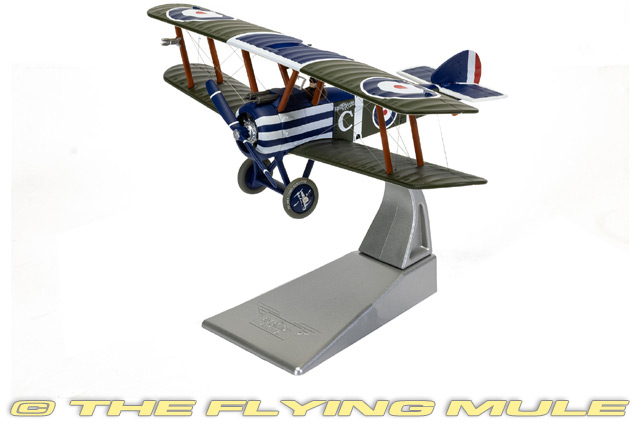
Corgi Aviation Archive Collector Series AA38111
Sopwith Camel Diecast Model
RNAS No.10 Sqn , B7190 Donner Wetter, Walter Hinchliff, Teteghem, France, 1918 | Limited Edition
800
Pieces Worldwide |
|
| 1:48 Scale | | Length | | Width |
|---|
| Sopwith Camel | | 4.75" | | 7" |
Liverpudlian Walter "Hinch" Hinchliffe began his military career with a British Army artillery unit, but in 1916, joined the Royal Naval Air Service. After training, he was posted to Cranwell as an instructor, where he clocked up an impressive 1,250 flight hours in 13 months of flying.
In January 1918, he joined No.10 Squadron. RNAS at Teteghem near Dunkirk, and scored his first victory in a Sopwith Camel on 3rd February 1918. As the commander of "C" Flight, Hinchliffe's Sopwith Camel B7190 was one of the most distinctively presented aircraft of the squadron, with its blue and white detailing making it an attractive sight for Allied and Luftstreitkrafte pilots alike. The spine of his aircraft carried a representation of the Liverpool coat of arms, and the wheel covers had little devils painted on them. The wording "Donner Wetter" painted on either side of the fuselage is German for "thunderstorm" - fitting for a pilot who enjoyed such a meteoric rise through service. He used this aircraft to score his second and third victories in France, ending the war with six confirmed victories, confirming him as an ace pilot.
After the war, 'Hinch' was persuaded to fly a wealthy heiress across the Atlantic, as she wanted to become the first woman to do so. Tragically, both aircraft and passengers were lost without trace during the attempt.
Designed as a heavier, more powerful refinement of the Sopwith Pup, the Camel was first flown in 1917. Earning its name from the distinctive humped fairing surrounding its twin .303 Vickers machine guns, the Camel's unforgiving flight characteristics claimed the lives of many students in flight training. In the hands of a skilled pilot though, it was an extreme dogfighter that could out-maneuver any contemporary with the possible exception of the Fokker Dr.I. Common for airplanes of that era, a fixed crankshaft configuration allowed the entire engine to spin with the propeller, creating strong gyroscopic forces that adversely affected the airplane's handling under power. Together with the S.E.5a, the Camel helped gain superiority over the German Albatros and is credited with shooting down 1,294 enemy aircraft, more than any other Allied fighter. © Copyright 2003-2026 The Flying Mule, Inc.
Corgi's 1:48 scale Camels are some of the most historically significant aircraft included in their WWI aircraft series. WWI fighters were relatively small in comparison to their WWII counterparts and 1:48 scale captures significant details that would be lost in smaller scales. The model uses fine gauge wire to represent the structurally significant bracing wires found on the actual aircraft. Additionally, the mold faithfully replicates the complex contours of the entire aircraft, simulating a stretched fabric covering. A detailed pilot figure sits behind the twin Vickers machine guns while the top wing includes the inboard cut-outs, so essential to the pilot's forward visibility in a dogfight. Up front, the propeller and engine are nicely detailed and free to rotate in unison behind the cowling, just as with the real aircraft. The model rests on rolling rubber tires that accurately reproduce the gray color vulcanized natural rubber takes on after prolonged exposure to sunlight.
© Copyright 2003-2026 The Flying Mule, Inc.
The Corgi "Aviation Archive" range presents highly-detailed, ready-made diecast models of military and civilian aircraft. The vast Aviation Archive range has become the standard by which all other diecast airplane ranges are judged. Each Corgi model is based on a specific aircraft from an important historical or modern era of flight, and has been authentically detailed from original documents and archival library material. Famous airplanes and aviators from both military and commercial airline aviation are all honored.
Corgi "Aviation Archive" diecast airplanes feature:
- Diecast metal construction with some plastic components.
- Realistic panel lines, antennas, access panels and surface details.
- Pad printed markings and placards that won't fade or peel like decals.
- Interchangeable extended/retracted landing gear with rotating wheels.
- Poseable presention stand to display the aircraft "in flight".
- Many limited editions with numbered certificate of authenticity.
- Detailed, hand-painted pilot and crew member figures.
- Authentic detachable ordnance loads complete with placards.
- Selected interchangeable features such as speed-brakes, opened canopies and access panels.
- Selected moving parts such as gun turrets, control surfaces and swing-wings.
© Copyright 2003-2026 The Flying Mule, Inc.