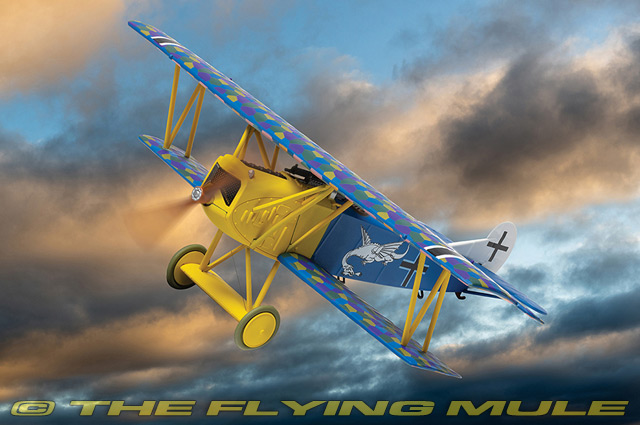
Corgi Aviation Archive Collector Series AA38909
Fokker D.VII Diecast Model
Luftstreitkrafte Jasta 19, Wilhelm Leusch, France, 1918 | |
| 1:48 Scale | | Length | | Width |
|---|
| Fokker D.VII | | 5.75" | | 7.25" |
PLEASE NOTE: This item is not currently in stock and has a planned arrival date of January 2027.- Orders may not ship until complete. If you wish to receive in-stock items prior to pre-ordered items, you must place separate orders.
- Arrival dates are subject to change. Consider them to be estimates as manufacturers frequently revise them.
- Credit Cards are not billed until time of shipment. PayPal payment (not recommended) is required at time of order.
For an aircraft which was only photographed during the very final weeks of the Great War, it's interesting to note just how much detail the Jasta 19 artist managed to incorporate into his beautiful design on this Fokker D.VII fighter. The immaculately painted dragon was an identical copy of the image carried on an advert for the Unterberg and Helme Company, a firm famous for the design and production of world leading engine ignition systems at that time, but why was it replicated so perfectly when Germany was clearly losing the war remains something of a mystery?
Although Wilhelm Leusch joined the Luftstreitkrafte in October 1914, he was initially posted to fly artillery spotting missions over the Western Front, and it wouldn't be until after joining Royal Prussian Jasta 19 in April 1917 that he started scoring aerial victories. Promoted to command the unit in October 1918 following the death of the previous commander, Leusch wouldn't increase his victory tally of 5 enemy aircraft destroyed, as the Allies had such overwhelming superiority at that time, despite the unrivalled fighting credentials of the Fokker D.VII. By the end of the war, this distinctively presented Fokker was pictured under French control, although it isn't known whether this was the result of a combat engagement, of if Leusch had flown it there as part of the armistice terms, like so many other surviving Fokker D.VIIs.
Designed by Reinhold Platz to participate in Germany's first single-seat fighter competition, the D.VII prototype (V.11) was first flown in December 1917. Constructed of fabric-covered wire-braced welded steel tubing and powered by an innovative 160 horsepower engine, the D.VII's greatest strength was its maneuverability at high altitudes. D.VII aircrews were equipped with two synchronized 7.92mm machine guns, with which they achieved some remarkable kill-to-loss ratios. By the end of WWI, the Fokker D.VII was regarded as the best German fighter in service, so good, in fact, that one of the Allies' Armistice terms was that all Fokker D.VII's be surrendered. © Copyright 2003-2026 The Flying Mule, Inc.
Corgi's 1:48 scale Fokker D.VII has select parts constructed in diecast metal, including the lower wing and fuselage, bulkhead ribs and engine access panels. The top wing and rear control surfaces are made of plastic, which allows for greater detail on the ailerons, rudder and elevators. The cylinder heads of the inline six-cylinder BMW IIIa engine feature a separately applied exhaust pipe, and the undercarriage has fine gauge wire between the landing gear and simulated vulcanized natural rolling rubber tires. Additional details include a beautifully simulated wood propeller, delicate photo etched radiator grill and a detailed pilot figure sitting behind twin Spandau machine guns.
© Copyright 2003-2026 The Flying Mule, Inc.
The Corgi "Aviation Archive" range presents highly-detailed, ready-made diecast models of military and civilian aircraft. The vast Aviation Archive range has become the standard by which all other diecast airplane ranges are judged. Each Corgi model is based on a specific aircraft from an important historical or modern era of flight, and has been authentically detailed from original documents and archival library material. Famous airplanes and aviators from both military and commercial airline aviation are all honored.
Corgi "Aviation Archive" diecast airplanes feature:
- Diecast metal construction with some plastic components.
- Realistic panel lines, antennas, access panels and surface details.
- Pad printed markings and placards that won't fade or peel like decals.
- Interchangeable extended/retracted landing gear with rotating wheels.
- Poseable presention stand to display the aircraft "in flight".
- Many limited editions with numbered certificate of authenticity.
- Detailed, hand-painted pilot and crew member figures.
- Authentic detachable ordnance loads complete with placards.
- Selected interchangeable features such as speed-brakes, opened canopies and access panels.
- Selected moving parts such as gun turrets, control surfaces and swing-wings.
© Copyright 2003-2026 The Flying Mule, Inc.