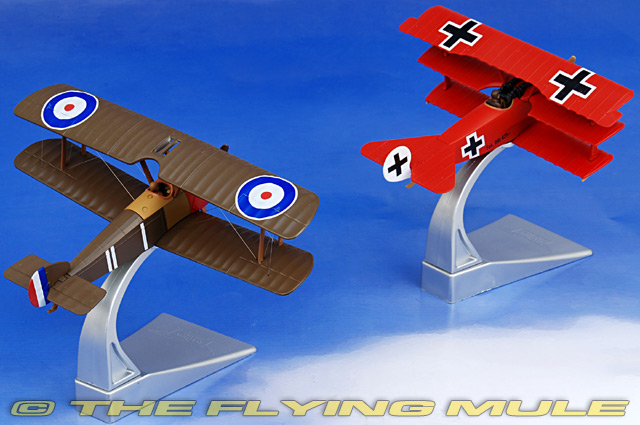
Corgi Aviation Archive Collector Series AA39913
Diecast Model
The Red Baron vs. Arthur Brown, April 21st 1918, 2-Piece Set | Limited Edition
1200
Pieces Worldwide |
|
| 1:48 Scale | | Length | | Width |
|---|
| Fokker Dr.I Triplane | | 4.75" | | 6" |
| Sopwith Camel | | 4.75" | | 7" |
Captain Arthur Roy Brown was the Canadian World War I Flying Ace who was officially credited by the RAF with bringing down Germany's most successful Ace, the infamous 'Red Baron', Manfred von Richthofen. On the morning of April 21st, 1918 Brown's 209 Squadron Sopwith Camels were set upon by von Richthofen's infamous 'Flying Circus'. At some point during the ensuing dog-fight Brown's high-school friend, Wop May, broke away from the battle but was spotted and pursued by von Richthofen. Brown saw his friend in trouble and in turn took pursuit of von Richthofen. Soon all 3 aircraft were snaking around at tree-top height. What actually happened next has remained controversial to this day. Both Brown and ground based anti-aircraft gunners sent long bursts of fire at von Richthofen and he eventually crashed only a few hundred yards from the front line. Although Brown was accredited with bringing down the 'Red Baron' it is now largely believed that he was actually shot by an Australian gunner on the ground, probably Sergeant Cedric Popkin of the Australian 24th Machine Gun Company.
Designed in response to the highly maneuverable Sopwith Triplane, the Fokker Dr.I was first flown in 1917 and was one of the most successful and recognizable combat aircraft of WWI, attributing much of its fame to the German WWI ace Manfred von Richthofen - the iconic "Red Baron". Light weight, small size and three wings made the aircraft highly maneuverable and deadly in the hands of an expert pilot but very unforgiving of less experienced pilots. Common for airplanes of that era, a fixed crankshaft configuration allowed the entire engine to spin with the propeller, creating strong gyroscopic forces that adversely affected the airplane's handling under power. © Copyright 2003-2025 The Flying Mule, Inc.
Designed as a heavier, more powerful refinement of the Sopwith Pup, the Camel was first flown in 1917. Earning its name from the distinctive humped fairing surrounding its twin .303 Vickers machine guns, the Camel's unforgiving flight characteristics claimed the lives of many students in flight training. In the hands of a skilled pilot though, it was an extreme dogfighter that could out-maneuver any contemporary with the possible exception of the Fokker Dr.I. Common for airplanes of that era, a fixed crankshaft configuration allowed the entire engine to spin with the propeller, creating strong gyroscopic forces that adversely affected the airplane's handling under power. Together with the S.E.5a, the Camel helped gain superiority over the German Albatros and is credited with shooting down 1,294 enemy aircraft, more than any other Allied fighter. © Copyright 2003-2025 The Flying Mule, Inc.
Corgi's 1:48 scale Camels are some of the most historically significant aircraft included in their WWI aircraft series. WWI fighters were relatively small in comparison to their WWII counterparts and 1:48 scale captures significant details that would be lost in smaller scales. The model uses fine gauge wire to represent the structurally significant bracing wires found on the actual aircraft. Additionally, the mold faithfully replicates the complex contours of the entire aircraft, simulating a stretched fabric covering. A detailed pilot figure sits behind the twin Vickers machine guns while the top wing includes the inboard cut-outs, so essential to the pilot's forward visibility in a dogfight. Up front, the propeller and engine are nicely detailed and free to rotate in unison behind the cowling, just as with the real aircraft. The model rests on rolling rubber tires that accurately reproduce the gray color vulcanized natural rubber takes on after prolonged exposure to sunlight.
Corgi's 1:48 scale Dr.Is capture the unmistakable lines of the real aircraft, including ailerons that extend beyond the upper wing-tips. Fine gauge wire represents the structurally significant bracing wires found on the actual aircraft. Additionally, the mold faithfully replicates the complex contours of the entire aircraft, simulating a stretched fabric covering. A detailed pilot figure sits behind the twin Spandau machine guns. Up front, the propeller and engine are nicely detailed and free to rotate in unison behind the cowling. The model rests on rolling rubber tires that accurately reproduce the gray color vulcanized natural rubber takes on after prolonged exposure to sunlight.
© Copyright 2003-2019 The Flying Mule, Inc.
The Corgi "Aviation Archive" range presents highly-detailed, ready-made diecast models of military and civilian aircraft. The vast Aviation Archive range has become the standard by which all other diecast airplane ranges are judged. Each Corgi model is based on a specific aircraft from an important historical or modern era of flight, and has been authentically detailed from original documents and archival library material. Famous airplanes and aviators from both military and commercial airline aviation are all honored.
Corgi "Aviation Archive" diecast airplanes feature:
- Diecast metal construction with some plastic components.
- Realistic panel lines, antennas, access panels and surface details.
- Pad printed markings and placards that won't fade or peel like decals.
- Interchangeable extended/retracted landing gear with rotating wheels.
- Poseable presention stand to display the aircraft "in flight".
- Many limited editions with numbered certificate of authenticity.
- Detailed, hand-painted pilot and crew member figures.
- Authentic detachable ordnance loads complete with placards.
- Selected interchangeable features such as speed-brakes, opened canopies and access panels.
- Selected moving parts such as gun turrets, control surfaces and swing-wings.
© Copyright 2003-2025 The Flying Mule, Inc.