|
| | Code: CG-FS10004 
Status: Sold out - Discontinued
We regret this item is no longer available for sale. Please see the product description for links to similar items we still have available. | Corgi Showcase Collection FS10004
Diecast Model
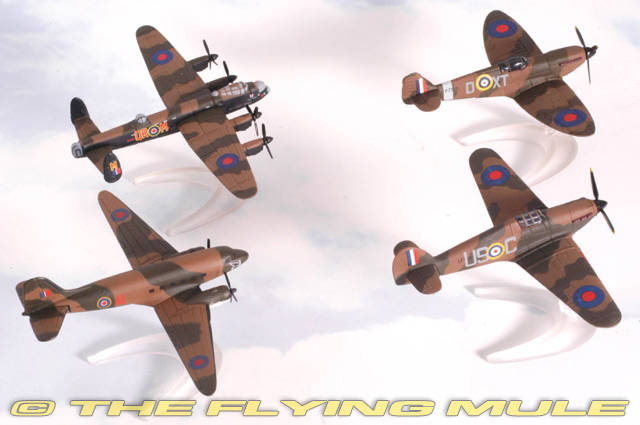
RAF BBMF, 4-Piece Set |
| 1:120 Scale | | Length | | Width |
|---|
| Avro Lancaster B.Mk I | | 7" | | 10.25" | | Douglas DC-3 | | 6.5" | | 9.5" | | Supermarine Spitfire Mk V | | 3" | | 3.75" | | Hawker Hurricane Mk I | | 3.25" | | 4" |
The Battle of Britain Memorial Flight (BBMF) is a Royal Air Force flight which provides an aerial display group comprising an Avro Lancaster, a Supermarine Spitfire and a Hawker Hurricane. The aircraft are regularly seen at events commemorating World War II, upon British State occasions and at air displays throughout the United Kingdom and Europe. The Flight is administratively part of No. 1 Group RAF, flying out of RAF Coningsby in Lincolnshire. Designed to meet a specification for a new generation of "worldwide use" medium bombers, the Avro Lancaster was first flown on January 8, 1941. The design of the Lancaster evolved from an unsuccessful two-engine aircraft called the Manchester. The heavier Lancaster had four engines and an extensive bomb bay, with later versions capable of carrying 22,000 lb bombs. Used primarily as a night bomber, the Lancaster was a versatile aircraft that became most famous for its role in the 1943 "Dam Buster" raids on Germany's Ruhr Valley dams. Between 1942 and 1945, Lancasters flew 156,000 sorties, dropping 608,612 tons of bombs on enemy targets. © Copyright 2003-2025 The Flying Mule, Inc. Designed to meet an American Airlines requirement for an enlarged version of the DC-2, the DC-3 was first flown on December 17th, 1935. Capable of carrying 24 passengers at a cruising speed of 180 mph, the DC-3's speed and long range revolutionized commercial air travel in the 1930s and 40s, when it carried 90 percent of the world's air travelers. Early DC-3s used Wright R-1820 Cyclone engines, but Pratt & Whitney R-1830 Twin Wasp Radials were fitted to later versions; these engines had better single engine performance and allowed the DC-3 to fly at higher altitudes. © Copyright 2003-2025 The Flying Mule, Inc. Designed by R.J.Michell to meet a British Air Ministry specification, the Supermarine Spitfire first flown on March 5th, 1936. With its combination of beautiful fighter design, the excellent performance of its Rolls-Royce Merlin powerplant and firepower provided by twin cannons and four machine guns, the Spitfire became an unrivaled symbol of victory. The Spitfire had 40 major variants and was built in greater numbers than any other British aircraft of the time. It flew operationally on every front between 1939 and 1945 and was engaged in every one of the Royal Air Force's major actions. © Copyright 2003-2025 The Flying Mule, Inc. Based on the Fury biplane and designed by Sydney Camm as a monoplane fighter, the Hurricane was first flown on November 6th, 1935. With its wide-set landing gear, easy handling, reliability, and stable gun platform, the Hurricane was suitable for a variety of different roles such as intruder, ground strafing and night fighter. Steel-tube construction meant cannon shells could pass right through the wood and fabric covering without exploding. The Hurricane underwent many modifications during its lifetime, including an upgraded Merlin engine and interchangeable multi-purpose wings, staging twelve 7.7mm guns and two 40mm anti-tank guns and carrying two 500lb bombs. © Copyright 2003-2025 The Flying Mule, Inc. The Corgi "Showcase Collection" range presents affordable, ready-made diecast models of military and civilian aircraft. Corgi "Showcase Collection" diecast airplanes feature: - Diecast metal construction with some plastic components.
- Realistic panel lines and surface details.
- Pad printed markings that won't fade or peel like decals.
- Poseable stand to display the aircraft "in flight".
- Moving parts such as propellers, rotors and swing-wings where applicable.
- Descriptive, collectible data card.
© Copyright 2003-2025 The Flying Mule, Inc. | |
|
|
|
|
|
|