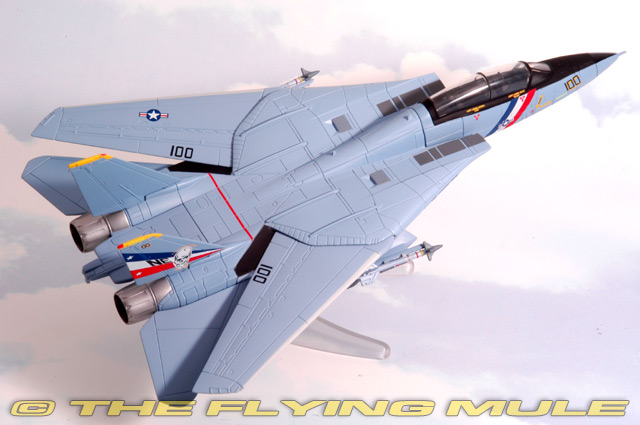
Corgi Aviation Archive Collector Series US95141
Grumman F-14D Tomcat Diecast Model
USN VF-2 Bounty Hunters, NE100, USS Constellation, 2003 |
| 1:64 Scale | | Length | | Width |
|---|
| Grumman F-14D Tomcat | | 11.75" | | 12" |
An icon of US Naval aviation since its entry into service in the early 1970s, the Grumman F-14 Tomcat was conceived and built as the ultimate long range air superiority fighter interceptor of the Cold War. Boasting the powerful AWG-9 radar system and awesome AIM-54 Phoenix ultra long range air-to-air missile, the swing-wing Tomcat entered frontline service in late 1972. Over 550 F-14s were subsequently built, and no fewer than 29 fleet-assigned units were to fly the aircraft for the next two decades.
Faced with premature retirement post Operation Desert Storm, the F-14 community developed the "Bombcat" in the early 1990s as a "swing mission" fighter-bomber, using the "off-the-shelf" LANTIRN (low-altitude navigation and targetin infra-red night) targeting pod. The "Bombcat" has duly proven its worth in the "mud-moving" business in a succession of campaigns over the past eight years, seeing action in Iraq, Afghanistan, Bosnia-Herzogovina, Serbia and Kosovo.
In March 2003 a total of five F-14 units, operating from supercarriers in the Northern Arabian Gulf and easter Mediterranean, enjoyed the jet's finest hour in Operation Iraqi Freedom (OIF). Equipped with an arsenal of precision-guided munitions such as the laser-guided GBU-12 bomb and the hugely impressive GBU-31 Joint Direct Attack Munition, these units made a huge contribution to the Coalition victory in this campaign.
Designed to carry the formidable long range AIM-54 Phoenix missile, the Grumman F-14 Tomcat was first flown on December 21st, 1970. Made famous by the Hollywood film Top Gun, the F-14 replaced the F-4 Phantom II as the US Navy's primary maritime air superiority fighter. Its design includes a variable geometry wing that can sweep back for high speed supersonic intercepts and forward for improved positioning in air to air dogfights. Nicknamed "Bombcat," the F-14 spent much of its late career in an air-to-ground role, carrying the Low Altitude Navigation and Targeting Infrared for Night (LANTIRN) system. © Copyright 2003-2025 The Flying Mule, Inc.
The Corgi "Aviation Archive" range presents highly-detailed, ready-made diecast models of military and civilian aircraft. The vast Aviation Archive range has become the standard by which all other diecast airplane ranges are judged. Each Corgi model is based on a specific aircraft from an important historical or modern era of flight, and has been authentically detailed from original documents and archival library material. Famous airplanes and aviators from both military and commercial airline aviation are all honored.
Corgi "Aviation Archive" diecast airplanes feature:
- Diecast metal construction with some plastic components.
- Realistic panel lines, antennas, access panels and surface details.
- Pad printed markings and placards that won't fade or peel like decals.
- Interchangeable extended/retracted landing gear with rotating wheels.
- Poseable presention stand to display the aircraft "in flight".
- Many limited editions with numbered certificate of authenticity.
- Detailed, hand-painted pilot and crew member figures.
- Authentic detachable ordnance loads complete with placards.
- Selected interchangeable features such as speed-brakes, opened canopies and access panels.
- Selected moving parts such as gun turrets, control surfaces and swing-wings.
© Copyright 2003-2025 The Flying Mule, Inc.