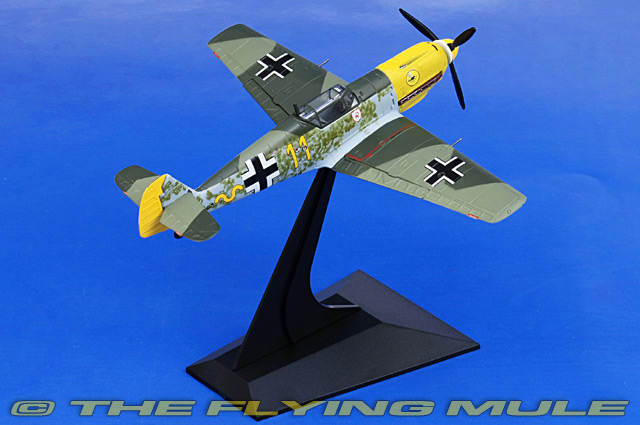
Dragon Models 1:72 Warbirds 50048
Messerschmitt Bf 109E Diecast Model
Luftwaffe 9./JG 2 Richthofen, "Yellow 11", Battle of Britain, 1940 |
| 1:72 Scale | | Length | | Width |
|---|
| Messerschmitt Bf 109E | | 5" | | 5.5" |
JG 2 got it's nickname from very famous WW I ace, Manfred von Richthofen, or 'Red Baron' as he is more commonly know. JG 2's badge was red 'R' on white background.
The Messerschmitt Me 109 (Bf 109 was the official Reichsluftfahrtministerium designation, though some late-war aircraft actually carried the Me 109 designation stamped onto their aircraft type plates. Me 109 was the name used officially by the Luftwaffe propaganda publications as well as by the Luftwaffe personnel) was a World War II fighter aircraft designed in the early 1930s, the first truly modern fighter of the era combining the features of all-metal monocoque construction, a closed canopy and a retractable landing gear. The Me 109E-1 was the first production model of the Me 109E version. The first E-1 was produced in the summer of 1938 after the tests of prototypes Me109 V13 and V14. Compared with the early versions, the E-1 had its radiators under the wings. Its armament consisted of two wing-mounted MG-17 machine guns and an optional 250kg bomb. It was powered by a DB-601A engine and had a top speed of about 350mph with a ceiling of 34500 feet. The first operational debut of the E-1 was the Spanish
A major campaign of World War II, the Battle of Britain is the name for the attempt by Germany's Luftwaffe to gain control of British airspace and destroy the Royal Air Force (RAF). Secondary objectives were to destroy aircraft production and intimidate the nation into neutrality or surrender. The campaign was launched as preparation for a planned invasion of Britain called Operation Sea Lion. British historians state the battle ran from 10 July to 31 October 1940, which was the most intense period of daylight air raiding. However, German sources begin the battle in mid-August 1940 and end it in May 1941 on the withdrawal of the bomber units in preparation for the attack on Russia. The Battle of Britain was not the first major battle to be fought entirely in the air, as the British mainland had already suffered a campaign of attacks by Zeppelins and long range bombers during World War I. However, the battle was the largest and most sustained bombing campaign yet attempted and the first real test of the strategic bombing theories that had emerged since the previous World War.
Designed to meet a Luftwaffe need for a single-seat fighter/interceptor, the Messerschmitt Bf 109 was first flown on May 28th, 1935. Its all-metal construction, closed canopy and retractable gear made the Bf 109 one of the first true modern fighters of WWII. This versatile aircraft served in many roles and was the most produced aircraft of the war and the backbone of the Luftwaffe, and was flown by Germany's top three aces, who claimed a total of 928 victories between them. Armed with two cannons and two machine guns, the Bf 109's design underwent constant revisions, which allowed it to remain competitive until the end of the war. © Copyright 2003-2025 The Flying Mule, Inc.
Dragon's Bf 109 series includes the early E model and the later aerodynamically improved G model with a "tropical" air filter for tropical/desert theatre releases. This model's optional center mounted drop tank is easy to configure and installs quickly. The one-piece main gear subassembly is robust and easily slips and locks into place. The canopy is configurable and can be displayed in the open position, allowing for easy viewing of the cockpit interior and instrument panel details. The rudders are moveable on both variants as are the flaps on the G model, a feature uncommon in 1:72 scale.
© Copyright 2003-2013 The Flying Mule, Inc.
The Dragon Models "Dragon Wings 1:72 Warbirds Series" range presents highly-detailed, ready-made diecast models of military aircaft.
Dragon Models "Dragon Wings 1:72 Warbirds Series" diecast airplanes feature:
- Diecast metal construction with some plastic components.
- Realistic panel lines, antennas, access panels and surface details.
- Pad printed markings and placards that won't fade or peel like decals.
- Opening canopies, revealing detailed cockpit interiors.
- Selected moveable control surfaces.
- Interchangeable extended/retracted landing gear.
- Presentation stand to display the aircraft "in flight".
- Authentic detachable ordnance loads complete with placards.
- Accurately detailed underside with concealed screwheads.
© Copyright 2003-2025 The Flying Mule, Inc.