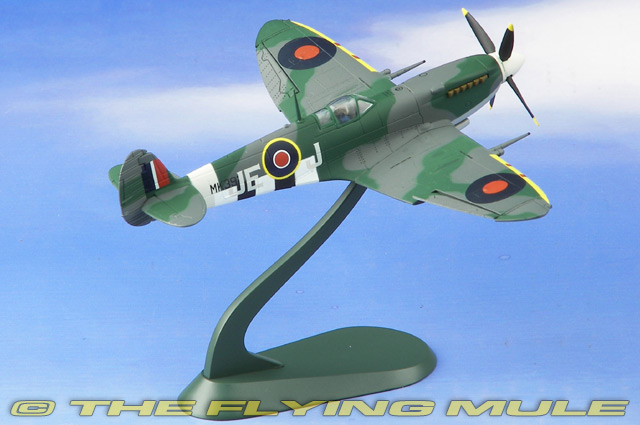
GeminiJets Gemini Aces GARAF1001
Supermarine Spitfire Mk IX Diecast Model
RAF No.141 (Canadian) Wing, MK392, Johnnie Johnson, Normandy, France, 1944 | |
| 1:72 Scale | | Length | | Width |
|---|
| Supermarine Spitfire Mk IX | | 5.25" | | 6.25" |
This particular aircraft was the mount of the RAF's leading 'Ace' to survive WWII – Wing Commander 'Johnnie' Johnson. Johnson shot down 38 enemy aircraft over the skies of Northern Europe, made all the more remarkable by the fact that all these victories came against single engined fighters! The aircraft carried his initials JE – J and displays the later 'Scheme C' Invasion Stripe identification markings, which were restricted to the aircrafts under-surfaces only.
The Supermarine Spitfire is arguably the most famous fighter aircraft of the Second World War. The type was in constant production throughout WWII and some 22,000 aircraft were built before the production ceased in the post war years. The Mark IX Spitfire was a thoroughbred fighting machine. Developed from the Spitfire Mk V variant, it was a direct response to the threat posed by the Luftwaffe's new Focke Wulf FW 190A, which made a dramatic impact on the European Air War. So potent was this new German fighter that the RAF suspended operations over occupied Europe, as losses began to mount. The Spitfire Mk IX was more than a match for the FW 190 and became the Spitfire with which the RAF took to the offensive against Luftwaffe units in Northern Europe.
This particular aircraft was the mount of the RAF's leading 'Ace" to survive WWII- Wing Commander "Johnnie' Johnson. Johnson shot down 38 enemy aircraft over the skies of Northern Europe, made all the more remarkable by the fact that all these victories came against single engined fighters! The aircraft carried his initials JE – J and displays the later Scheme C' Invasion Stripe identification markings, which were restricted to the aircrafts under-surfaces only.
Designed by R.J.Michell to meet a British Air Ministry specification, the Supermarine Spitfire first flown on March 5th, 1936. With its combination of beautiful fighter design, the excellent performance of its Rolls-Royce Merlin powerplant and firepower provided by twin cannons and four machine guns, the Spitfire became an unrivaled symbol of victory. The Spitfire had 40 major variants and was built in greater numbers than any other British aircraft of the time. It flew operationally on every front between 1939 and 1945 and was engaged in every one of the Royal Air Force's major actions. © Copyright 2003-2026 The Flying Mule, Inc.
Gemini's 1:72 scale Spitfire is constructed using more diecast metal than most other models on the market today. This quality model boasts an all metal propeller and spinner hub—features uncommon in this scale—all metal landing gear and exhaust stacks, a solid metal antenna, a metal scale tail wheel and movable elevators and rudders with metal hinges. Other fine details include a nose scope that securely attaches to the landing gear for both ground and in-flight display. A delicate hand-painted mirror is mounted on the canopy, and the fuselage, wings and control surfaces are detailed with fine rivets and panel lines. Some variants have a clipped wing.
© Copyright 2003-2013 The Flying Mule, Inc.
The GeminiJets "Gemini Aces" range presents highly-detailed, ready-made diecast models of military aircraft.
GeminiJets "Gemini Aces" diecast airplanes feature:
- Diecast metal construction with minimal use of plastic components.
- Realistic panel lines, antennas, access panels and surface details.
- Pad printed markings and placards that won't fade or peel like decals.
- Detailed cockpit interiors.
- Selected moveable control surfaces.
- Interchangeable extended/retracted landing gear with rotating wheels.
- Metal presentation stand to display the aircraft "in flight".
- Authentic ordnance loads complete with placards.
- Photo-etched, spinning metal propellers.
- Accurately detailed underside with concealed screwheads.
© Copyright 2003-2026 The Flying Mule, Inc.