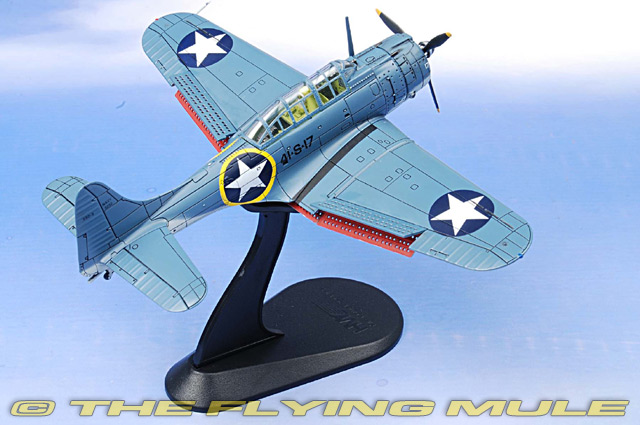
Hobby Master 1:72 Air Power Series HA0126
Douglas SBD-3 Dauntless Diecast Model
USN VS-41, USS Ranger, North Africa, Operation Torch, November 1942, w/Opened Dive Brakes |
| 1:72 Scale | | Length | | Width |
|---|
| Douglas SBD-3 Dauntless | | 5.5" | | 7" |
At 0000 GMT on November 8, 1942 "Operation Torch" began. It was the most ambitious naval operation in the European-African theater. It was a combined effort by British and U.S. forces to dislodge the French Vichy forces from Morocco and Algeria. Also with Operation Torch taking place it means that the British under Montgomery aren't the only opposition for Rommel. The Vichy government was formed by German sympathizers after France surrendered to Germany. It basically was a puppet government for the Nazis. With the Vichy out of the way this would clear the path for the Allies to rid North Africa of Rommel's Afrika Corps and become a gateway to Italy and open another front for the Germans to have to contend with. Negotiations to have the Vichy forces not resist had begun but by the time the operation had started there was no agreement reached. This meant that there would be bloodshed and loss of life on both sides. There were 5 U.S. carriers involved in the attacks on Morocco with VS-41 "Top Hatters" aboard the USS Ranger (CV-4) being part of the group. They took part in the bombing missions that either destroyed or crippled several French Naval vessels. One being a submarine while it was still tied up at its berth. A large portion of the French Air Force was destroyed in the air and on the ground. The SBD's were a fairly new plane to VS-41 as it was only in September 1942 that the very inadequate SB2U Vindicators were replaced by them. On November 10th, just when the U.S. forces had prepared to attack Casablanca the French stopped fighting in that area. The attacks further east along the Algerian coast met with heavy Resistance as they didn't have the same amount of air cover. The attacks from German planes take a toll but Allied forces manage to establish a beachhead and begin their assault. Eventually the Germans are able to stop the offensive and Ike calls off the mission but not before it has cost the Germans a great deal of its means of supply and support. This devastating loss would eventually end up costing Germany the war in North Africa. Designed as a light bomber and reconnaissance aircraft, various versions of the Dauntless served during the war with the US Marine Corps, Army and Navy. The Dauntless not only served well in the Pacific but is quite often overlooked for the major role it played in the Atlantic. It was used in attacks on German shipping off the coast of Norway, participated in Operation Torch in Morocco, and some even flew sub patrols. Not having the greatest of speed the SBD-3 was dubbed "Speedy 3".
First flown in 1938, The Douglas SBD Dauntless was the United States Navy's main dive-bomber during World War II. The Dauntless featured "Swiss cheese" flaps-dive brakes punched with 3-inch holes, which helped it achieve pinpoint accuracy when diving to the target. The cockpit accommodated the pilot, who doubled as the bombardier and manned a fixed-forward gun. The rear cockpit contained a machine gun and played a major defensive role. During the Battle of Midway, SBD dive-bomber attacks fatally damaged all four of the Japanese aircraft carriers, and heavily damaged two cruisers. © Copyright 2003-2025 The Flying Mule, Inc.
Hobby Master's 1:72 scale SBD Dauntless is constructed almost entirely from diecast metal, with plastic components used to achieve maximum detail. The large bird-cage style canopy has fine rivet details and is removable for an unobstructed view of the cockpit with pad-printed instrumentation, direction finding antenna and rear gunner station with machine gun. The swing arm that cradles the center mounted bomb is positionable and can be displayed in the pre-launch configuration. Some releases feature perforated dive brakes that are either fixed in the closed position or in the deployed position, and some include under-wing mounted bombs and antenna. Variants in the series include both early and later versions.
© Copyright 2003-2013 The Flying Mule, Inc.
The Hobby Master "1:72 Air Power Series" range presents detailed, ready-made diecast models of military aircraft.
Hobby Master "1:72 Air Power Series" diecast airplanes feature:
- Diecast metal construction with some plastic components.
- Realistic panel lines, antennas, access panels and surface details.
- Pad printed markings and placards that won't fade or peel like decals.
- Presentation stand to display the aircraft "in flight".
- Accurately detailed underside with concealed screwheads.
© Copyright 2003-2025 The Flying Mule, Inc.