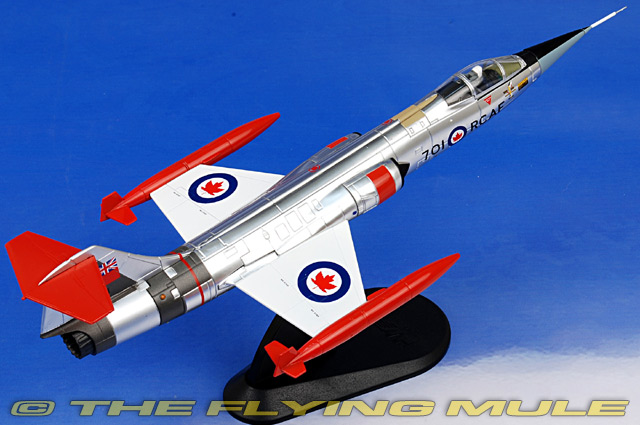
Hobby Master 1:72 Air Power Series HA1011
Canadair CF-104 Starfighter Diecast Model
CAF, CFB Cold Lake, Canada, 1967 | Limited Edition
1000
Pieces Worldwide |
|
| 1:72 Scale | | Length | | Width |
|---|
| Canadair CF-104 Starfighter | | 9.25" | | 3.75" |
The RCAF received their first CF-104 in March 1962. Although originally designed as a supersonic interceptor the Canadian Air Force used it primarily for low level strike and reconnaissance. The Canadian version of the F-104 was capable of carrying a ventral mounted Vinten Vicon pod with 4 cameras inside for reconnaissance picture taking.On September 4, 1963 number 12900 was the 200th and final CF-104 produced and entered service on January 10, 1964. The CF-104 retired from service in 1985 when it was replaced by the CF-18 Hornet. Over the 25 years of active service 110 aircraft were lost to accidents earning it nicknames like "Widow Maker" and "Lawn Dart". The RCAF CF-104 probably had the most flying time of any variant with an average of 6,000 hours per plane over their life time compared to the Luftwaffe's 3,000 hours.
Looking for a supersonic replacement for the RCAF aging Sabre Mk. 6 the Canadian Government chose the Lockheed F-104. This never was the choice of the Air Force but it was a decision based more on economics and politics. It was decided that Canadair would build the Canadian version under contract. Originally designated CL-90 the aircraft finally became the CF-104. In the spring of 1961 the first Canadian-built CF-104 serial number 12701 was airlifted to Palmdale, California where on May 26, Lockheed Test Pilot Ed Brown performed its maiden flight. The Canadair number for this Aircraft was 683a-1001, the RCAF serial number was 12701 but in July 1970 renumbered as 104701. In 1967 aircraft 12701 was one of 5 aircraft sent to the Central Experimental and Proving Establishment (CEPE) located at Cold Lake Alberta Canada. These aircraft were used for evaluations and flight trials of all the aircraft modifications, systems and armaments. In 1985, possibly after being cannibalized, it was struck off the inventory list and later scrapped.
Designed to meet a need for an aircraft that could successfully compete against the MiG-15 in Korea, the F-104 Starfighter was first flown on February 20, 1958. American pilots believed that the F-86 Sabre was too large and complex to outmaneuver the lighter MiG, and they wanted a smaller, simpler, high-performance aircraft to replace it. The resulting design was a light, aerodynamic airframe wrapped around a powerful J79 turbojet engine. The F-104C was used by the USAF from 1958 until 1967, but most of the 2,578 production Starfighters were built and flown by members of NATO, including the Italian Air Force, which didn't retire it until 2004. © Copyright 2003-2026 The Flying Mule, Inc.
Hobby Master's 1:72 scale F-104 Starfighter is a good looking model with many quality features. The exceptionally long fuselage is constructed in diecast metal, with plastic side-mounted engine intakes. The rear turbine blades and the exhaust with its "turkey feathers" are some of the high points of this model, along with a canopy that opens to reveal an ejection seat and pad printed front and side instrument panels. The M61 Vulcan Gatling gun port is beautifully recreated, and the complex main landing gear is accurately rendered, securely locking into place for ground display. Most releases include removable wingtip fuel tanks, with fuselage mounted missiles on some versions.
© Copyright 2003-2013 The Flying Mule, Inc.
The Hobby Master "1:72 Air Power Series" range presents detailed, ready-made diecast models of military aircraft.
Hobby Master "1:72 Air Power Series" diecast airplanes feature:
- Diecast metal construction with some plastic components.
- Realistic panel lines, antennas, access panels and surface details.
- Pad printed markings and placards that won't fade or peel like decals.
- Presentation stand to display the aircraft "in flight".
- Accurately detailed underside with concealed screwheads.
© Copyright 2003-2026 The Flying Mule, Inc.