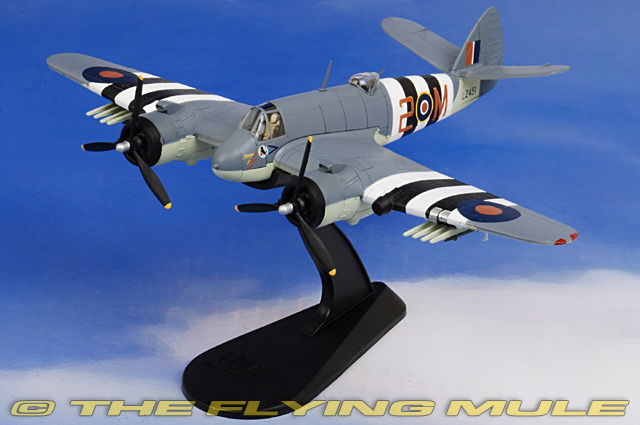
Hobby Master 1:72 Air Power Series HA2309
Bristol Beaufighter TF.Mk X Diecast Model
RCAF Coastal Command No.404 Sqn, D-Day, June 6th 1944 |
| 1:72 Scale | | Length | | Width |
|---|
| Bristol Beaufighter TF.Mk X | | 7" | | 9.75" |
The RCAF 404 Squadron was known as the "Buffalo Squadron". In June 1944 the squadron was part of RAF Coastal Command stationed at Davidstow Moor, in North Cornwall. On June 4, 1944 the aircraft received their D-Day invasion stripes. On June 6, 1944 three German Narvik Class destroyers were sighted proceeding up the English Channel towards the D-Day landing. Fourteen Beaufighters from 404 were sent to intercept the ships. Armed with 25-pound SAP (semi-armor piercing) RP (Rocket Projectiles) they found their targets and attacked the lead ship and then the second. Both were left on fire while the third ship used ship number 2 as cover. All aircraft returned to base to refuel and rearm for a second strike. The ships were located again and with two of them smoking the third ship was the main target. It too was set afire but as it turns out the three ships managed to limp back to port and within two days they were back in the English Channel. It was later determined that 74 of the 96 RP's found their targets. This time they encountered the 10th Destroyer Flotilla that destroyed one ship, drove another onto the rocks and forced the third back to Brest. RCAF 404 Squadron received their Beaufighters in September 1942 and never flew against ground targets and never carried anything but RP's. In April 1945 404 Squadron switched to Mosquitos. LZ451 2-M (2 signifying Davidstow Moor) was crewed by F/L WR Christison from Lennoxville, Quebec and F/L Toon.
Designed to counter the growing threat of the Luftwaffe, the British Bristol Beaufighter-known as "Beau"-first flew on July 17th, 1939. The rugged Beaufighter had two-speed supercharged radial engines mounted well ahead of the wing leading edges. The cockpit was located in the snub nose, which gave the pilot an excellent forward view. A navigator, wireless operator and rear gunner were positioned in a rear cupola. The Beau's premier role was as a nightfighter, but it was also used as a long-range fighter and developed into an antishipping and ground attack cannon rocket-firing fighter, torpedo plane and tactical bomber. © Copyright 2003-2026 The Flying Mule, Inc.
Hobby Master's 1:72 scale Bristol Beaufighter is constructed almost entirely from diecast metal with a large thick solid metal wing and stubby nose. The fuselage features four 20mm cannon ports with vents for spent shell casings, simulated fabric stretched control surfaces and removable canopies that open to reveal pad-printed instrument panels, control yoke and side-mounted equipment. The wing has six gun ports on the leading edge and seamlessly-blended engine nacelles and cooling fins on each cylinder head. Variants in the series include the TF.Mk.X torpedo fighter with removable torpedo, the night fighter Mk.IF with "herringbone" antenna and the all-weather/night attack Mk.VIF with its "thimble-nose" radome.
© Copyright 2003-2013 The Flying Mule, Inc.
The Hobby Master "1:72 Air Power Series" range presents detailed, ready-made diecast models of military aircraft.
Hobby Master "1:72 Air Power Series" diecast airplanes feature:
- Diecast metal construction with some plastic components.
- Realistic panel lines, antennas, access panels and surface details.
- Pad printed markings and placards that won't fade or peel like decals.
- Presentation stand to display the aircraft "in flight".
- Accurately detailed underside with concealed screwheads.
© Copyright 2003-2026 The Flying Mule, Inc.