|
| | Code: MU-PK0017 
Status: Sold out - Discontinued
We regret this item is no longer available for sale. Please see the product description for links to similar items we still have available. | Mule Packs PK0017
*Mule Pack*
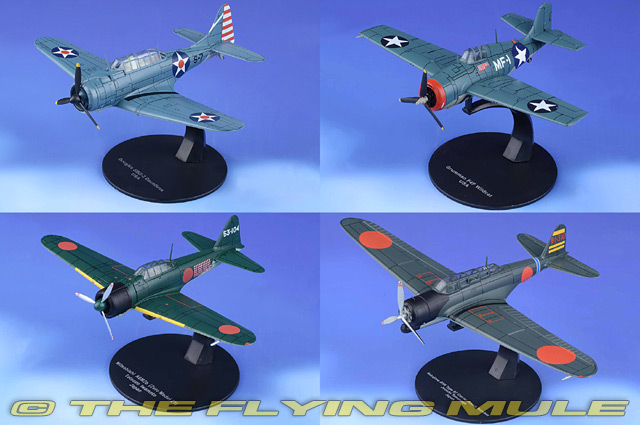
Pacific Air War 4-Piece Bundle |
| 1:72 Scale | | Length | | Width |
|---|
| Douglas SBD Dauntless | | 5.5" | | 7" | | Grumman F4F Wildcat | | 4.75" | | 6.25" | | Mitsubishi A6M2 Zero-Sen/Zeke | | 5" | | 6.5" | | Nakajima B5N2 Kanko/Kate | | 5.75" | | 8.5" |
DA-DAWF42 De Agostini SBD Dauntless Diecast Model, USN VS-6, Black S-7, Dale Hinton/Jack Leming, USSFor the pre-dawn launch on March 4th, the Enterprise Air Group enjoyed much better weather than it had at Wake Island. The strike group consisted of 32 SBDs, with 6 VF-6 F4Fs as escort in the event that aircraft were based at Marcus" still-under-construction airfield. Attacking first, VB-6's SBDs went after runways and other air facilities - oil tanks, repair shops, and revetments. Several hits were scored which cratered the runway and demolished a suspected hangar. VS-6 followed and scored additional direct hits on a radio building, but anti-aircraft fire was heavy which forced the pilots to escape the area quickly with little opportunity to assess bomb damage. One SBD was badly hit and set on fire by a shell, which forced the pilot to ditch 10 miles of the coast of Marcus. The crew was soon picked up by a Japanese patrol boat, and spent the next three years in captivity. The strike group, less the ditched SBD and the lost F4F, recovered back aboard the Enterprise shortly after 9am, and the carrier turned around to head east for safety.DA-DAWF18 De Agostini F4F Wildcat Diecast Model, USMC VMF-224 Fighting Bengals, MF-I, RobertBrigadier General Robert Edward Galer (24 October 1913 - 27 June 2005) was a naval aviator in the United States Marine Corps. In May 1942, Galer assumed command of Marine Fighting Squadron 224 (VMF-224) and on 30 August 1942 led the squadron to Guadalcanal, where they became part of the Cactus Air Force. It was while in command of VMF-224 that Galer would be credited with 11 confirmed victories and be awarded the Medal of Honor and a rare British Distinguished Flying Cross for the same acts of heroism. He went on to command Marine Aircraft Group 12 during the Korean War and retired a few years after in 1957.DA-DAWF64 De Agostini A6M2 Zero-Sen/Zeke Diecast Model, IJNAS, Tetsunzo IwamotoTetsuzo Iwamoto became a 1st Class Airman in December 1936. In 1938 he was sent to China where on February 25, 1938 Iwamoto downed three Chinese fighters and one probable. In September 1938 with fourteen victories to his credit, Iwamoto returned to Japan as an instructor. In October 1943 Iwamoto and the 201st AG were sent to Rabaul and were confronted with USAAF 5th AF bombing and strafing. While on Rabaul Iwamoto scored 142 of his 202 victories over almost every type of aircraft the Allies flew in the Pacific.DA-DAWF75 De Agostini B5N2 Kanko/Kate Diecast Model, IJNAS Hiryu Flying Group, BI-310, JoichiAt 0430 on June 4, 1942 the Japanese Strike Force launched a Strike Force of 108 aircraft from four aircraft carriers. The three wave attack consisted of 36 B5N2 Kates armed with 1,770 pound contact bombs, 36 Val dive-bombers with 550 pound armor-piercing bombs and escorted by 36 Zero fighters. Lt. Joichi Tomonaga flying a Kate from the Hiryu was in charge of the airborne operation. Later the same day while leading an attack on USS Yorktown Tomonaga was killed trying to deliver his Kate's torpedo. First flown in 1938, The Douglas SBD Dauntless was the United States Navy's main dive-bomber during World War II. The Dauntless featured "Swiss cheese" flaps-dive brakes punched with 3-inch holes, which helped it achieve pinpoint accuracy when diving to the target. The cockpit accommodated the pilot, who doubled as the bombardier and manned a fixed-forward gun. The rear cockpit contained a machine gun and played a major defensive role. During the Battle of Midway, SBD dive-bomber attacks fatally damaged all four of the Japanese aircraft carriers, and heavily damaged two cruisers. © Copyright 2003-2026 The Flying Mule, Inc. Designed to meet a US Navy requirement for a new carrier-based fighter, the F-4F was first flown on September 2nd, 1937. Originally used by the British (who called it the Martlet) against the Luftwaffe, the Wildcat also became the United States Navy's primary carrier fighter in the Pacific Theatre. The Wildcat was no match for the maneuverability of the Japanese Zero, but the two airplanes were roughly equal in speed and the F-4F was able to absorb far more damage. With its array of 6 x 12.7mm machine guns and its distinctive Thach weave maneuver, two Wildcats could handle four or five Zeros. © Copyright 2003-2026 The Flying Mule, Inc. First flown in April, 1939, the A6M Zero-Sen was the Allies' main opponent in the Pacific and the most famous symbol of Japanese air power during World War II. This carrier-based fighter, designed with a low-monoplane wing and armed with a formidable array of two 20mm cannons and two 7.7mm machine guns, proved capable of handling any of the Allies' aircraft. It wasn't until the Allies studied a captured Zero that they were able to identify and exploit weaknesses such as minimal pilot and fuel tank protection. Zeros became infamous for Kamikaze attacks, in which pilots would intentionally crash explosion-laden aircraft into Allied ships. © Copyright 2003-2026 The Flying Mule, Inc. Designed to meet a 1935 Imperial Japanese Navy requirement for a carrier-based attack bomber to replace the Yokosuka B4Y, the B5N was first flown in January, 1937. © Copyright 2003-2026 The Flying Mule, Inc. The Flying Mule's "Mule Packs" offer hand-picked product combinations at low, low prices. Load up today and save $$$.
Note: The product selections are final and no substitutions are possible. © Copyright 2003-2026 The Flying Mule, Inc. | |
|
|
|
|
|
|